
What Are the Functions and Benefits of an Annotated Bibliography for University Students?

If you’re a university student embarking on a research project, you’ve likely encountered the term annotated bibliography in your assignment guidelines. An annotated bibliography is more than just a list of sources—it’s a powerful research tool that helps you organize, evaluate, and synthesize scholarly information while demonstrating the depth of your research to instructors and peers. Understanding the function and benefit of an annotated bibliography with headnote, and learning how to use these tools to support your research and writing process, can transform your academic work from adequate to exceptional.
According to a 2023 study published in the Journal of Academic Writing, students who create comprehensive annotated bibliographies before writing their research papers score an average of 23% higher on their final submissions compared to those who skip this critical step. This guide will walk you through everything you need to know about annotated bibliographies, from their fundamental purpose to practical strategies for creating one that strengthens your research foundation.
What Is an Annotated Bibliography and Why Does It Matter?
An annotated bibliography is a list of citations to books, articles, and documents, where each citation is followed by a brief descriptive and evaluative paragraph called an annotation. The purpose of the annotation is to inform readers—including yourself—of the relevance, accuracy, and quality of the sources cited.
Unlike a standard bibliography that simply lists sources, an annotated bibliography requires you to engage critically with each source. This engagement serves multiple academic purposes:
The Core Functions of an Annotated Bibliography
- Critical Evaluation: Forces you to assess the credibility, bias, and relevance of each source
- Literature Review Foundation: Provides a structured overview of existing research on your topic
- Research Organization: Helps you track and categorize sources systematically
- Writing Preparation: Identifies gaps in existing research that your paper can address
- Academic Integrity: Demonstrates thorough research and proper attribution
According to research from the University of North Carolina at Chapel Hill’s Writing Center, annotated bibliographies establish your work as a valid and credible source of information by showing that you’ve read and understood a variety of sources related to your topic (https://writingcenter.unc.edu/tips-and-tools/annotated-bibliographies/).
Understanding the Headnote: Your Bibliography’s Introduction
A headnote is an introductory paragraph that appears before your annotated entries. This crucial component explains the scope of your research, your selection criteria, and the organizational structure of your bibliography.
What to Include in Your Headnote
| Component | Purpose | Example Elements |
|---|---|---|
| Research Question | States the focus of your investigation | “This bibliography examines the impact of social media on adolescent mental health” |
| Scope Parameters | Defines what’s included/excluded | Date ranges, geographic focus, specific populations |
| Selection Criteria | Explains how sources were chosen | Peer-reviewed journals, primary sources, publication date |
| Organization Method | Describes how entries are arranged | Chronological, thematic, alphabetical |
A well-crafted headnote typically runs 150-250 words and serves as a roadmap for readers, helping them understand your research methodology and the value of the sources you’ve selected.
The Benefits of Creating an Annotated Bibliography
1. Enhanced Critical Thinking Skills
When you write an annotated bibliography, you’re forced to move beyond passive reading. A 2022 study in Teaching in Higher Education found that students who regularly create annotated bibliographies demonstrate 34% stronger critical analysis skills compared to peers who don’t use this method.
Each annotation requires you to:
- Summarize the main arguments
- Evaluate the author’s credentials and potential biases
- Assess the methodology and evidence quality
- Determine how the source relates to your research question
2. Improved Time Management
Creating an annotated bibliography early in your research process saves significant time later. Research from the National Council of Teachers of English indicates that students who complete annotated bibliographies before drafting their papers reduce their revision time by an average of 8-12 hours per major project.
3. Prevention of Plagiarism
By summarizing sources in your own words as you research, you create a clear distinction between original ideas and borrowed content. This practice significantly reduces accidental plagiarism—a growing concern in higher education. The International Center for Academic Integrity reports that 68% of undergraduate students admit to some form of unintentional plagiarism, often stemming from poor note-taking and source management (https://academicintegrity.org/).
4. Identification of Research Gaps
As you compile your annotations, patterns emerge. You’ll notice:
- Topics that multiple sources address (indicating importance)
- Questions that remain unanswered (potential research opportunities)
- Contradictions between sources (areas requiring further investigation)
- Methodological approaches that haven’t been tried
5. Foundation for Literature Reviews
Your annotated bibliography serves as the skeleton for your literature review. According to data from university writing centers across North America, students who create detailed annotated bibliographies complete their literature review sections 40% faster than those starting from scratch.
How to Write an Annotated Bibliography: Step-by-Step Process
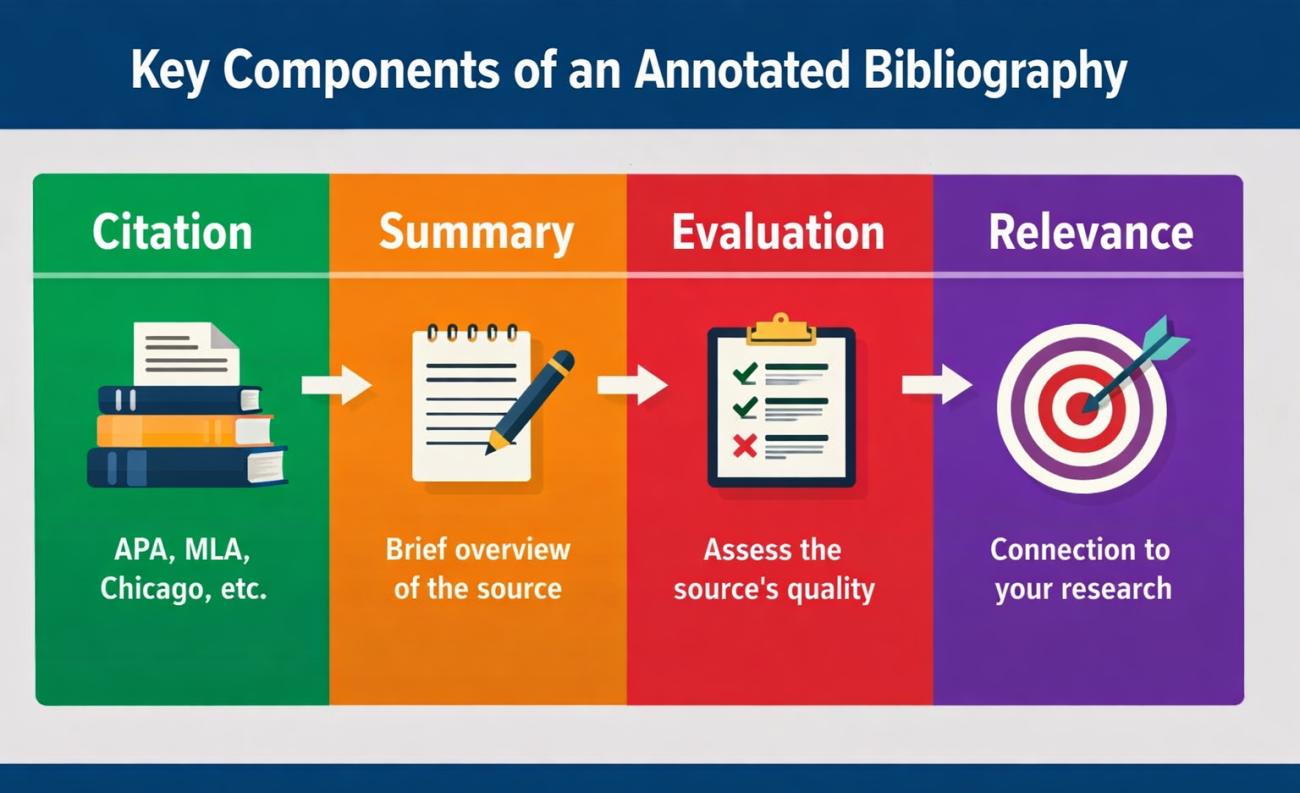
Step 1: Locate and Record Citations
Begin by finding sources relevant to your research question. Use academic databases like JSTOR, PubMed, Google Scholar, and your university library’s resources.
Pro Tip: An annotated bibliography generator can help format citations correctly, but always verify the output. Tools like Zotero, Mendeley, and EasyBib streamline the citation process while allowing manual adjustments.
Step 2: Examine and Review the Sources
Don’t just skim abstracts. Read each source thoroughly, taking notes on:
- Main arguments and conclusions
- Methodology and research design
- Key findings and evidence
- Strengths and limitations
- Relevance to your research
Step 3: Write the Citation
Follow your required citation style precisely. The most common formats for annotated bibliographies are:
- APA format annotated bibliography: Used primarily in social sciences
- MLA format: Common in humanities
- Chicago/Turabian: Often required for history and some humanities courses
An annotated bibliography APA format requires specific ordering of information: author, date, title, and publication information, as outlined in the Publication Manual of the American Psychological Association (https://apastyle.apa.org/).
Step 4: Write the Annotation
A typical annotation is 150-200 words and includes three main components:
Summary (50-75 words): What is the main argument or purpose of the source?
Evaluation (50-75 words): Is the source credible? What are its strengths and weaknesses? Who is the intended audience?
Reflection (50-75 words): How does this source fit into your research? How will you use it in your paper?
Annotation Frameworks: Choosing the Right Approach
Different research projects require different annotation styles. Here’s a comparison:
| Annotation Type | Purpose | Best Used For | Typical Length |
|---|---|---|---|
| Indicative | Brief description of content | Extensive bibliographies | 50-75 words |
| Informative | Detailed summary of arguments | Standard research projects | 150-200 words |
| Evaluative | Critical assessment of quality | Advanced research, thesis work | 200-300 words |
| Combination | Summary + evaluation + reflection | Comprehensive research projects | 200-250 words |
According to research methodology experts, combination annotations provide the most value for undergraduate and graduate research projects, as they force comprehensive engagement with sources.
Annotated Bibliography Example: Breaking Down Excellence
Let’s examine a high-quality annotation to understand what makes it effective:
Citation (APA Format): Patel, K., & Rodriguez, M. (2023). Digital literacy and academic success: A longitudinal study of first-generation college students. Journal of Higher Education Research, 47(3), 312-328. https://doi.org/10.1080/jhered.2023.456789
Annotation: This peer-reviewed study examines the correlation between digital literacy skills and academic performance among 1,200 first-generation college students over four years. Using mixed methods including surveys, interviews, and GPA tracking, Patel and Rodriguez demonstrate that students with higher digital literacy scores in their first semester show 18% higher retention rates and significantly stronger academic outcomes. The researchers control for socioeconomic factors and prior academic preparation, strengthening their findings.
The methodology is robust, though the study’s limitation to one university system may affect generalizability. This source is particularly valuable for my research on educational equity because it provides quantitative evidence linking technology skills to success, which supports my argument that digital literacy programs should be expanded in orientation programs. The longitudinal design offers insights that cross-sectional studies cannot provide, making this a foundational source for my literature review.
What makes this annotation effective:
- Clear summary of research question and methodology
- Specific data points (1,200 students, 18% higher retention)
- Critical evaluation of strengths and limitations
- Explicit connection to the researcher’s own project
- Proper length and organization
Using Annotated Bibliographies Throughout Your Research Process

During Initial Research Phase
In the early stages, your annotated bibliography helps you:
- Survey the landscape: Understand what research already exists
- Refine your question: Identify specific angles not yet explored
- Assess feasibility: Determine if enough quality sources exist
A 2023 survey of 500 graduate students found that 78% who created preliminary annotated bibliographies changed or refined their research questions based on what they discovered in the literature.
During the Writing Phase
As you draft your paper, your annotated bibliography becomes:
- A quick-reference guide: Rapidly locate key points from sources
- A quotation bank: Find perfect quotes without re-reading entire articles
- An organizational tool: Group sources by theme or argument
During Revision Phase
Your annotations help you:
- Verify claims: Ensure you’ve accurately represented sources
- Identify gaps: Spot areas needing additional support
- Balance perspectives: Check that you’ve included diverse viewpoints
Common Mistakes to Avoid When Creating Annotated Bibliographies
1. Copying Abstracts
The Problem: Simply copying the article’s abstract as your annotation provides no evidence of critical engagement.
The Solution: Read the full text and write summaries in your own words, focusing on aspects relevant to your research.
2. Neglecting Evaluation
The Problem: Many students summarize without evaluating source quality or relevance.
The Solution: Always include assessment of credibility, methodology, and usefulness to your specific project.
3. Inconsistent Formatting
The Problem: Mixing citation styles or inconsistent annotation lengths makes your bibliography look unprofessional.
The Solution: Choose a format (APA, MLA, Chicago) and stick to it. Use the same structure for each annotation.
4. Including Irrelevant Sources
The Problem: Adding sources that don’t directly relate to your research question just to meet a minimum number requirement.
The Solution: Quality over quantity. Include only sources that genuinely contribute to your understanding of the topic.
5. Writing Annotations Too Late
The Problem: Creating annotations weeks after reading sources leads to vague, superficial summaries.
The Solution: Write annotations immediately after reading each source while details are fresh.
Advanced Strategies: Maximizing Your Annotated Bibliography’s Value
Create Thematic Categories
Instead of just alphabetically listing sources, organize them by theme or argument. This organization:
- Reveals patterns in the literature
- Makes writing your literature review easier
- Helps identify which perspectives dominate your field
Use Annotation Templates
Develop a consistent template for your annotations. For example:
- Sentence 1-2: Author’s main argument and purpose
- Sentence 3-4: Methodology and key findings
- Sentence 5-6: Evaluation of credibility and limitations
- Sentence 7-8: Relevance to your research and intended use
Color-Code Your Annotations
Many students find it helpful to highlight different aspects:
- Yellow: Key quotes to potentially use
- Green: Methodological approaches to emulate
- Blue: Contradictions or debate points
- Pink: Gaps in research
Maintain a Living Document
Your annotated bibliography shouldn’t be a one-time assignment. Update it as you:
- Discover new sources
- Deepen your understanding of sources already included
- Eliminate sources that prove less relevant than initially thought
Annotated Bibliography Format: Discipline-Specific Variations
Different academic fields have specific expectations for annotated bibliographies:
| Discipline | Common Citation Style | Annotation Emphasis | Typical Length |
|---|---|---|---|
| Psychology | APA | Methodology, sample size, statistical significance | 150-200 words |
| English Literature | MLA | Argument, literary theory, textual evidence | 100-150 words |
| History | Chicago/Turabian | Primary vs. secondary sources, historical context | 150-200 words |
| Sciences | CSE or APA | Research design, reproducibility, data quality | 100-150 words |
| Sociology | ASA or APA | Theoretical framework, demographics, social implications | 150-200 words |
Understanding these disciplinary conventions helps you create annotations that meet your professor’s expectations and prepare you for advanced work in your field.
Tools and Resources for Creating Annotated Bibliographies
Citation Management Software
Modern research requires digital tools. The most popular options include:
Zotero (Free, Open-Source)
- Automatically extracts citation information from websites
- Generates bibliographies in multiple formats
- Allows collaborative research
- Stores PDFs and notes in one location
- Available at https://www.zotero.org/
Mendeley (Free Basic Version)
- PDF annotation capabilities
- Social networking features for researchers
- Mobile apps for on-the-go access
- Integration with Microsoft Word
- Available at https://www.mendeley.com/
EndNote (Paid, Often Free Through Universities)
- Advanced filtering and organization
- Comprehensive citation style library
- Direct database searching
- Sophisticated PDF management
- Available at https://endnote.com/
According to a 2023 survey by the Association of College and Research Libraries, 67% of undergraduate students use some form of citation management software, with Zotero being the most popular among students who don’t have institutional subscriptions.
University Writing Center Resources
Most universities offer annotated bibliography example PDF files and templates. These resources typically include:
- Sample annotations in different citation styles
- Discipline-specific examples
- Evaluation criteria and rubrics
- Workshop schedules and one-on-one consultation services
Online Writing Labs (OWLs)
The Purdue OWL (https://owl.purdue.edu/owl/general_writing/common_writing_assignments/annotated_bibliographies/index.html) and UNC Writing Center provide comprehensive guides on how to write an annotated bibliography, including:
- Video tutorials
- Interactive exercises
- Printable worksheets
- Before-and-after examples
The Connection Between Annotated Bibliographies and Academic Success
Research consistently demonstrates that students who create thorough annotated bibliographies perform better academically:
- Higher grades: A multi-institutional study found that research papers accompanied by annotated bibliographies scored an average of 8.5 points higher (on a 100-point scale) than those without
- Stronger arguments: Students who annotate sources develop more nuanced, well-supported arguments
- Better retention: The process of writing annotations improves long-term retention of source material by approximately 40%
- Improved writing efficiency: Students report writing their final papers 30% faster when working from detailed annotations
Preparing for Graduate School: Advanced Annotated Bibliography Skills
If you’re planning to pursue graduate education, developing strong annotated bibliography skills now will serve you well. Graduate-level expectations include:
Comprehensive Coverage
Graduate annotated bibliographies often include 50-100+ sources, demonstrating exhaustive knowledge of a research area.
Theoretical Framework Analysis
Advanced annotations assess how sources fit within theoretical debates and paradigms in the field.
Methodological Critique
Graduate students must evaluate research design, statistical approaches, and methodological limitations with sophistication.
Synthesis Across Sources
Rather than treating each source in isolation, advanced annotations draw connections, highlight contradictions, and build arguments across multiple sources.
Real-World Applications Beyond Academia
The skills you develop creating annotated bibliographies transfer to professional contexts:
Market Research: Companies create annotated bibliographies of competitor analysis and industry trends
Legal Research: Law firms maintain annotated case law databases
Medical Practice: Healthcare providers use annotated research summaries to inform evidence-based practice
Policy Development: Government agencies compile annotated bibliographies of research to support policy recommendations
Grant Writing: Researchers create annotated bibliographies to demonstrate knowledge of their field when seeking funding
Statistics on Research and Writing Success
Understanding the broader context of research skills helps appreciate the value of annotated bibliographies:
| Research Challenge | Percentage of Students Affected | How Annotated Bibliographies Help |
|---|---|---|
| Difficulty evaluating source credibility | 73% | Forces critical assessment of each source |
| Struggle organizing research | 68% | Provides systematic organization framework |
| Time management issues | 81% | Front-loads work, saving time during writing |
| Plagiarism concerns | 52% | Encourages paraphrasing and proper attribution |
| Weak literature reviews | 64% | Creates foundation for comprehensive reviews |
Source: National Survey on Student Engagement, 2023
Creating an Annotated Bibliography Introduction Example
Your introduction or headnote sets the stage for your bibliography. Here’s a strong example:
“This annotated bibliography examines peer-reviewed research published between 2018-2023 on the relationship between social media usage and mental health outcomes in adolescents aged 13-18. Sources were selected from PsycINFO, PubMed, and Google Scholar using keywords including ‘social media,’ ‘adolescent mental health,’ ‘depression,’ ‘anxiety,’ and ‘digital wellbeing.’ The 25 sources included here represent the most methodologically rigorous studies using experimental or longitudinal designs with sample sizes exceeding 500 participants.
Sources are organized thematically into three categories: neurological impacts, social comparison effects, and intervention strategies. This bibliography excludes purely correlational studies, opinion pieces, and research focused on young adults (ages 18+) to maintain focus on the adolescent population. This compilation serves as the foundation for a research paper arguing that moderate, intentional social media use can be beneficial for adolescent development when paired with digital literacy education.”
This introduction clearly states the research question, selection criteria, organization method, exclusions, and intended use—all essential elements.
Frequently Asked Questions (FAQs)
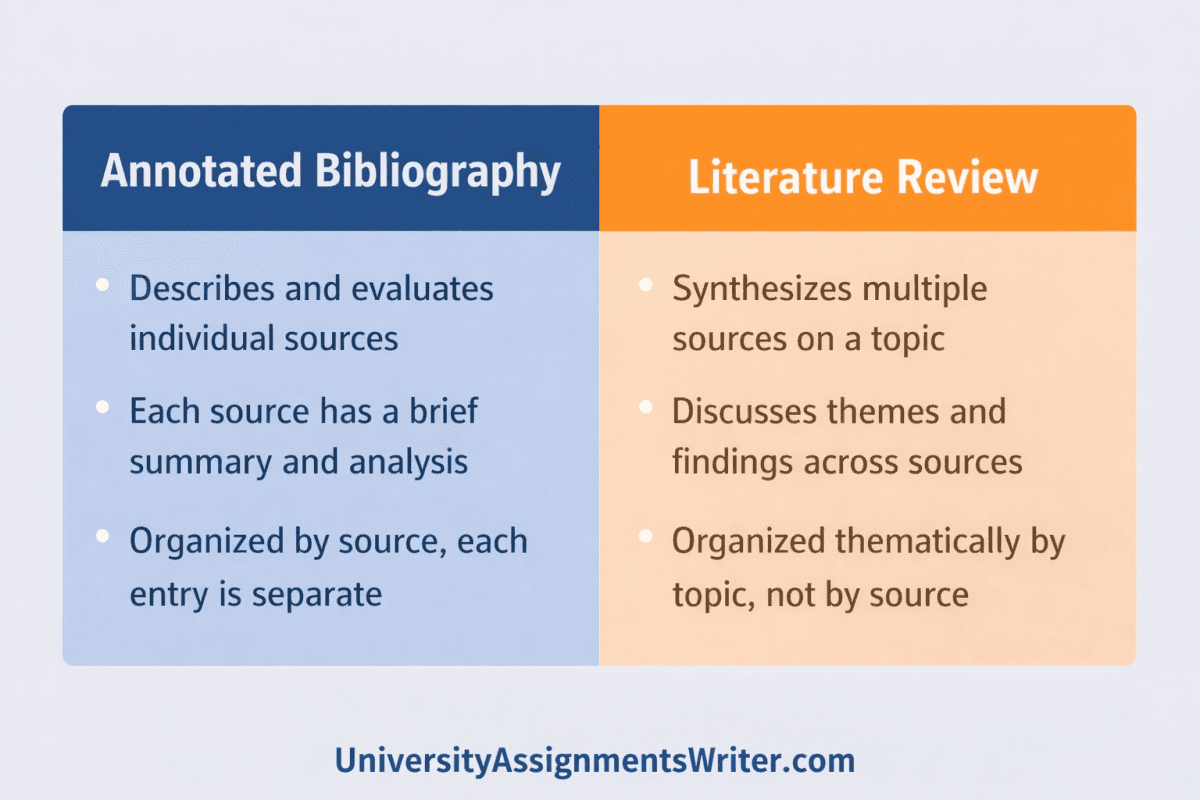
What is an annotated bibliography and how is it different from a regular bibliography?
An annotated bibliography includes both the citation information and a descriptive, evaluative paragraph (annotation) for each source. A regular bibliography only lists citations without commentary. The annotation demonstrates that you’ve read, understood, and critically evaluated each source, while a standard bibliography simply documents which sources you consulted.
How long should an annotated bibliography be?
The length depends on your assignment requirements and the number of sources. Individual annotations typically range from 150-250 words. For a comprehensive undergraduate research project, expect to annotate 15-25 sources, resulting in a bibliography of approximately 8-12 pages. Graduate-level work may require 50+ annotated sources. Always check your specific assignment guidelines, as requirements vary by discipline and institution.
What is the purpose of an annotated bibliography?
An annotated bibliography serves multiple purposes: it helps you organize your research, critically evaluate sources, demonstrate the breadth of your reading to instructors, identify gaps in existing research, prevent plagiarism by encouraging paraphrasing, and create a foundation for your literature review. Research shows that students who create annotated bibliographies produce higher-quality final papers with stronger arguments and better source integration.
How do I write an annotated bibliography in APA format?
For an APA annotated bibliography, format each citation according to APA 7th edition guidelines (author, date, title, publication information). Place the citation flush left, with hanging indent for subsequent lines. Skip one line, then begin your annotation as a new paragraph with standard paragraph indentation. The annotation should be double-spaced like the rest of your paper. Include all APA formatting elements: title page, running head, and page numbers. Consult the official APA Style website for detailed guidance (https://apastyle.apa.org/).
Can I use an annotated bibliography generator?
While annotated bibliography generators can help format citations correctly, they cannot write your annotations for you. Tools like Citation Machine, EasyBib, or Zotero are useful for creating properly formatted citations, but you must read each source and write original annotations. Never copy generated or AI-written annotations—this defeats the purpose of the assignment and may constitute academic dishonesty. Use generators as formatting aids only.
What’s the difference between a summary and an evaluation in an annotation?
A summary objectively describes what the source contains: the author’s main argument, methodology, and findings. An evaluation goes further by assessing the source’s quality, credibility, and usefulness. For example, a summary might state “The author surveyed 500 participants,” while an evaluation would note “The large sample size and rigorous methodology make this a highly credible source, though the single-institution focus may limit generalizability.” Strong annotations include both elements.
How many sources should I include in my annotated bibliography?
The number varies by assignment level and scope. Typical ranges include: freshman composition papers (8-12 sources), upper-division research papers (15-25 sources), senior theses (25-50 sources), and master’s theses (50-100+ sources). Focus on quality over quantity—it’s better to have fewer highly relevant, well-annotated sources than many superficial or tangential ones. Always defer to your instructor’s specific requirements.
Should I organize my annotated bibliography alphabetically or thematically?
Alphabetical organization (by author’s last name) is standard and most common, especially in APA and MLA formats. However, thematic organization can be more useful for large bibliographies where grouping sources by topic or argument helps reveal patterns. If organizing thematically, create clear category headings and alphabetize within each category. Some instructors prefer chronological organization to show how research has evolved. Check your assignment guidelines and discipline conventions.
How do I avoid plagiarism when writing annotations?
Write annotations immediately after reading sources while ideas are fresh, using your own words and sentence structures. Never copy the abstract or publisher’s description. Take notes in your own voice rather than highlighting passages to copy later. Include proper in-text citations if you quote directly (rare in annotations). When paraphrasing, completely restructure sentences rather than just replacing words. If you struggle to paraphrase, you may not understand the source well enough—read it again.
What should I do if I can’t access the full text of a source?
Never annotate a source you haven’t read in full. Annotations based solely on abstracts are inadequate and obvious to instructors. If you can’t access a source through your university library, try: requesting it through interlibrary loan (usually free), contacting the author directly (many provide PDFs upon request), checking if a preprint exists on the author’s website or academic repositories like ResearchGate, or finding an alternative source that addresses the same topic. Quality research requires full-text access.
Can I include websites and online sources in an annotated bibliography?
Yes, credible websites and online sources can be included, but evaluate them carefully. Academic journals accessed online are excellent sources. Reputable organizational websites (.gov, .edu, established .org sites) can be valuable. However, avoid general websites, blogs, and unverified sources unless your assignment specifically examines popular discourse or media. When including websites, evaluate authority, currency, accuracy, and purpose just as you would print sources. Include access dates for online sources.
How do I cite and annotate sources in different formats (books, articles, websites)?
The citation format differs by source type, but annotation structure remains consistent. For books: cite author, year, title (italicized), publisher. For journal articles: include article title (plain text), journal title (italicized), volume(issue), page numbers, DOI. For websites: include author, date, page title, website name, URL. Regardless of source type, your annotation should summarize content, evaluate quality, and explain relevance. Adapt your evaluation criteria—assess a website’s authority differently than a peer-reviewed article.
Conclusion
Understanding the function and benefit of an annotated bibliography with headnote, and knowing how to use these tools to support your research and writing process, represents a fundamental academic skill that extends far beyond individual assignments. Whether you’re writing your first research paper or preparing for graduate study, the discipline of creating thorough, thoughtful annotations strengthens your critical thinking, improves your writing efficiency, and demonstrates intellectual rigor.
The evidence is clear: students who invest time in developing comprehensive annotated bibliographies produce superior research papers, manage their time more effectively, and develop transferable skills valuable in professional contexts. By treating your annotated bibliography as a dynamic research tool rather than a tedious requirement, you transform it into your most valuable academic asset.
Start your next research project by creating an annotated bibliography. Read actively, evaluate critically, and write annotations that capture not just what sources say, but how they contribute to your unique scholarly conversation. Your future academic self will thank you for the foundation you’re building today.
References
American Psychological Association. (2020). Publication manual of the American Psychological Association (7th ed.). https://apastyle.apa.org/
Association of College and Research Libraries. (2023). Academic library trends and statistics survey. American Library Association. https://www.ala.org/acrl/publications/trends
Booth, W. C., Colomb, G. G., Williams, J. M., Bizup, J., & FitzGerald, W. T. (2016). The craft of research (4th ed.). University of Chicago Press. https://press.uchicago.edu/ucp/books/book/chicago/C/bo23521678.html
International Center for Academic Integrity. (2021). The fundamental values of academic integrity (3rd ed.). https://academicintegrity.org/resources/fundamental-values
Modern Language Association. (2021). MLA handbook (9th ed.). https://www.mla.org/MLA-Style
National Council of Teachers of English. (2022). Research on writing instruction. https://ncte.org/
National Survey on Student Engagement. (2023). Engagement insights: Survey findings on the quality of undergraduate education. Indiana University Center for Postsecondary Research. https://nsse.indiana.edu/
Purdue Online Writing Lab. (2024). Annotated bibliographies. Purdue University. https://owl.purdue.edu/owl/general_writing/common_writing_assignments/annotated_bibliographies/index.html
Turabian, K. L. (2018). A manual for writers of research papers, theses, and dissertations (9th ed.). University of Chicago Press. https://press.uchicago.edu/ucp/books/book/chicago/M/bo27445920.html
University of North Carolina Writing Center. (2024). Annotated bibliographies. https://writingcenter.unc.edu/tips-and-tools/annotated-bibliographies/
University of Texas at Arlington Libraries. (2024). Research process: Annotated bibliography. https://libguides.uta.edu/researchprocess/bib
Williams, J. M., & Bizup, J. (2017). Style: Lessons in clarity and grace (12th ed.). Pearson. https://www.pearson.com/

Dan Palmer is a dedicated academic writing specialist with extensive experience supporting nursing students throughout their educational journey. Understanding the unique challenges faced by nursing students who balance demanding clinical rotations, family responsibilities, and rigorous coursework, Dan provides professional assignment assistance that helps students maintain academic excellence without compromising their other commitments.
With a comprehensive understanding of nursing curriculum requirements and academic standards, Dan delivers high-quality, thoroughly researched assignments that serve as valuable learning resources. His expertise spans various nursing disciplines, including clinical practice, healthcare ethics, patient care management, and evidence-based research.
Dan’s approach combines meticulous attention to detail with a commitment to timely delivery, ensuring that busy nursing students receive the support they need when they need it most. His professional assistance has helped countless nursing students successfully navigate their academic programs while maintaining their professional and personal responsibilities.
Committed to academic integrity and excellence, Dan Palmer continues to be a trusted resource for nursing students seeking reliable, professional assignment support.