
Assignment Help

What are the elements of Campinha-Bacote’s process of cultural competence?
What are the elements of Campinha-Bacote’s process of cultural competence?

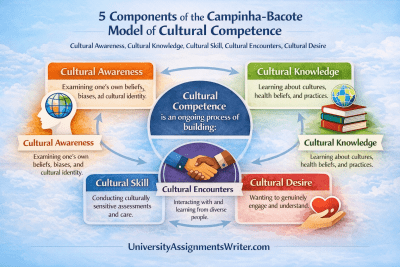
The elements of Campinha-Bacote’s process of cultural competence are cultural awareness, cultural knowledge, cultural skill, cultural encounters, and cultural desire. These five interrelated constructs form a dynamic and ongoing process that guides healthcare professionals in delivering culturally responsive and patient-centered care.

Campinha-Bacote conceptualizes cultural competence not as a static endpoint, but as a continuous journey. Her model, titled The Process of Cultural Competence in the Delivery of Healthcare Services, emphasizes that healthcare providers must actively engage in self-reflection, learning, and interaction to provide effective care in diverse societies. The model has been widely adopted in nursing education, advanced practice nursing, public health, and interprofessional healthcare training because of its practical applicability and focus on measurable behaviors.

What are the elements of Campinha-Bacote's process of cultural competence?

1. Cultural Awareness

Cultural awareness is the deliberate process of self-examination regarding one’s own cultural background, biases, assumptions, and potential prejudices. It requires healthcare providers to reflect on how their personal beliefs, values, and social positioning may influence their clinical judgment and interactions with patients.

This element goes beyond acknowledging that differences exist; it demands critical reflection on implicit bias, stereotyping, and ethnocentrism. For example, a nurse may unconsciously interpret a patient’s reluctance to maintain eye contact as noncompliance or disinterest, when in fact it may be a cultural sign of respect. Cultural awareness helps clinicians identify such biases before they negatively impact care delivery.

Importantly, Campinha-Bacote emphasizes that without cultural awareness, providers may impose their own worldview onto patients, leading to miscommunication, mistrust, and disparities in care outcomes (Campinha-Bacote, 2002).

2. Cultural Knowledge

Cultural knowledge refers to seeking and obtaining a sound educational foundation about diverse cultural and ethnic groups. This includes understanding health-related beliefs, disease prevalence, treatment preferences, family structures, communication styles, and health-seeking behaviors.

Cultural knowledge also involves recognizing how social determinants of health influence patient experiences. Structural inequities, socioeconomic status, immigration history, religious beliefs, and community norms all shape health outcomes. For example, certain populations may have higher prevalence rates of chronic conditions such as diabetes or hypertension due to environmental, dietary, or genetic factors.

However, Campinha-Bacote cautions against using cultural knowledge to stereotype. Rather than memorizing fixed “cultural traits,” providers should use knowledge as a framework to guide respectful inquiry and individualized care. Cultural knowledge supports evidence-based practice by integrating sociocultural context into clinical reasoning.

3. Cultural Skill

Cultural skill is the ability to collect culturally relevant data and perform culturally sensitive assessments. It involves translating awareness and knowledge into practical clinical competence.

In nursing practice, this includes conducting comprehensive assessments that explore patients’ explanatory models of illness. Clinicians may ask questions such as:

  • “What do you think caused your illness?”

  • “How do you usually treat this condition?”

  • “Are there cultural or spiritual practices we should consider in your care?”

  • “Who should be involved in healthcare decisions?”

Cultural skill also includes appropriate use of interpreter services, adapting patient education materials for health literacy levels, and negotiating treatment plans that align with cultural values. According to Campinha-Bacote (2011), cultural skill ensures that care plans are not only medically sound but also culturally congruent.

Without cultural skill, awareness and knowledge remain theoretical. Skill transforms competence into actionable clinical behaviors that directly influence patient outcomes.

4. Cultural Encounters

5 components of cultural competence

Cultural encounters involve direct cross-cultural interactions with patients from diverse backgrounds. These real-life interactions prevent healthcare professionals from relying on stereotypes and allow them to refine their understanding through experience.

Repeated cultural encounters increase comfort levels, reduce anxiety, and build confidence when working with diverse populations. Through encounters, providers learn that individuals within the same cultural group may differ significantly due to age, education, acculturation, personal values, or migration history.

Cultural encounters also contribute to improved communication and trust. Research has shown that patient-provider communication quality significantly affects adherence, satisfaction, and health outcomes (Saha, Beach, & Cooper, 2008). By engaging in meaningful encounters, providers enhance empathy and responsiveness, strengthening therapeutic relationships.

Importantly, cultural encounters should be intentional and reflective. Healthcare professionals are encouraged to evaluate what they learned from each interaction and identify areas for continued growth.

5. Cultural Desire

Cultural desire is the motivation to want to engage in the process of becoming culturally competent. Campinha-Bacote describes this as the “heart” of the model because it represents genuine interest rather than obligatory compliance.

Cultural desire differentiates between “I have to” and “I want to.” Healthcare providers with cultural desire actively seek opportunities to learn about diverse populations, advocate for equitable policies, and challenge systemic inequities. They demonstrate humility, openness, and respect in patient interactions.

Without cultural desire, the other four elements may be performed mechanically or superficially. Desire fuels lifelong learning and continuous professional development. It fosters authentic engagement rather than checklist-driven behavior.

The Dynamic Nature of the Model

Campinha-Bacote’s model is not linear. The five elements operate simultaneously and influence one another. For example, cultural encounters may increase cultural awareness by revealing implicit biases. Cultural knowledge may enhance cultural skill during assessments. Cultural desire motivates providers to seek further encounters and education.

The model aligns with patient-centered care principles and supports health equity initiatives. In increasingly multicultural societies, culturally competent care reduces disparities, enhances patient satisfaction, and improves safety outcomes. Cultural misunderstandings can lead to misdiagnosis, medication errors, nonadherence, and mistrust. Therefore, developing cultural competence is not optional; it is a professional and ethical obligation.

Relevance in Contemporary Healthcare

What are the elements of Campinha-Bacote's process of cultural competence?

Healthcare systems today serve populations characterized by racial, ethnic, linguistic, and religious diversity. Migration patterns, globalization, and demographic shifts require providers to be adaptable and culturally responsive.

The Campinha-Bacote model remains relevant because it emphasizes process over perfection. It recognizes that cultural competence is never fully achieved. Instead, it is cultivated continuously throughout one’s career. This approach encourages humility and lifelong learning—qualities essential in advanced nursing practice, public health, mental health services, and interprofessional collaboration.

Moreover, the model supports accreditation standards and nursing education competencies that emphasize diversity, equity, and inclusion. Many nursing curricula incorporate reflective exercises, case studies, simulation, and community engagement projects rooted in this framework.

Conclusion

Campinha-Bacote’s process of cultural competence consists of five core elements: cultural awareness, cultural knowledge, cultural skill, cultural encounters, and cultural desire. Together, these elements form a dynamic and lifelong process that equips healthcare professionals to deliver culturally congruent, ethical, and patient-centered care in diverse clinical environments.


References

Campinha-Bacote, J. (2002). The process of cultural competence in the delivery of healthcare services: A model of care. Journal of Transcultural Nursing, 13(3), 181–184. https://doi.org/10.1177/10459602013003003

Campinha-Bacote, J. (2011). Delivering patient-centered care in the midst of a cultural conflict: The role of cultural competence. Online Journal of Issues in Nursing, 16(2), Manuscript 5. https://ojin.nursingworld.org/table-of-contents/volume-16-2011/number-2-may-2011/cultural-competence-and-patient-centered-care/

Saha, S., Beach, M. C., & Cooper, L. A. (2008). Patient centeredness, cultural competence and healthcare quality. Journal of the National Medical Association, 100(11), 1275–1285. https://www.ncbi.nlm.nih.gov/pmc/articles/PMC2594253/

Kaihlanen, A.-M., Hietapakka, L., & Heponiemi, T. (2019). Increasing cultural awareness: Qualitative study of nurses’ perceptions about cultural competence training. BMC Nursing, 18, 38. https://bmcnurs.biomedcentral.com/articles/10.1186/s12912-019-0363-x