
Which Artistic Movement Is Usually Associated with Debussy’s Music?
Artistic Movement Usually Associated with Debussy’s Music
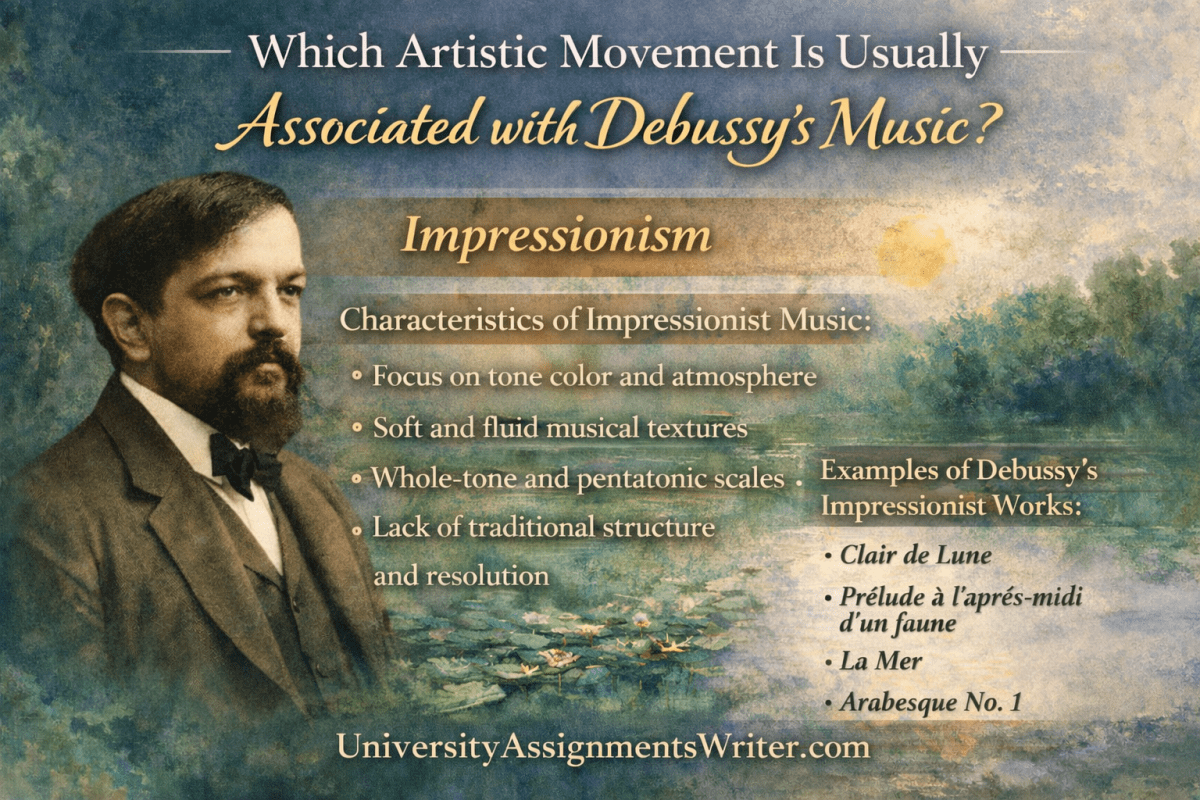
Claude Debussy is most commonly associated with Impressionism — an artistic movement that swept through late 19th-century France, reshaping first the visual arts and then music itself. His compositions reflect the movement’s defining preoccupation with atmosphere, color, and mood rather than adherence to traditional structural rules, placing him at the very center of one of the most influential aesthetic revolutions in Western cultural history (Trezise, 2003; Pasler, 1982).
The connection between Debussy and Impressionism is not merely one of historical proximity or convenient labeling. It is rooted in a genuine and profound alignment of artistic values. Just as Impressionist painters sought to capture the fleeting quality of light and sensation rather than the fixed solidity of objects, Debussy sought to capture in sound the shimmer of water, the weight of a winter morning, the haze of a warm afternoon — not by describing these things, but by evoking them directly through musical texture and color. That goal, pursued across three decades of extraordinary compositional output, produced a body of work that permanently changed what music could do and what it could mean.
II. Brief Background on Claude Debussy
Achille-Claude Debussy was born on August 22, 1862, in Saint-Germain-en-Laye, a town just outside Paris, and died in the French capital on March 25, 1918. His lifespan of 55 years placed him precisely at the hinge between two of the great eras in Western music history: the Romantic period, with its grand gestures and emotional intensity, and the Modernist era, with its systematic dismantling of inherited musical conventions. Debussy did not simply occupy this transitional space — he helped create it (Lockspeiser, 1962).
He entered the Paris Conservatoire at the age of ten, embarking on a formal musical education that would last more than a decade. Even as a student, Debussy displayed an instinctive resistance to the theoretical orthodoxies his professors sought to instill. He was famously argumentative in counterpoint and harmony classes, not because he lacked ability but because he heard possibilities that the rules were designed to exclude. This rebellious streak was not mere adolescent posturing — it reflected a genuinely original musical intelligence that was already searching for its own language (Roberts, 1996).
Debussy won the prestigious Prix de Rome in 1884 with his cantata L’Enfant prodigue, earning him a period of study in Rome. He returned to Paris more skeptical than ever of German Romanticism’s dominant influence, particularly the towering shadow of Richard Wagner. While Wagner’s innovations in chromatic harmony fascinated him, Debussy ultimately found the Wagnerian aesthetic — its epic scale, its programmatic ambition, its emotional excess — antithetical to the subtle, atmospheric art he was beginning to envision (Orledge, 1982).
The pivotal encounter that accelerated Debussy’s artistic development came at the 1889 Paris World Exposition, where he heard Javanese gamelan music for the first time. The gamelan ensemble’s shimmering, interlocking timbres, its use of scales entirely unlike the Western major-minor system, and its lack of the directed harmonic movement that governed European concert music were revelatory for the young composer (Mueller, 1986). Combined with his deep immersion in Symbolist poetry — particularly the work of Stéphane Mallarmé and Paul Verlaine — and his close observation of the Impressionist painters whose work filled the galleries of Paris, Debussy rapidly developed a compositional voice unlike anything the concert world had heard before.
The influence he went on to exert over 20th-century music was enormous and far-reaching. Composers as different in style as Maurice Ravel, Béla Bartók, Igor Stravinsky, Olivier Messiaen, and the American jazz pianist Bill Evans have all cited Debussy as a formative influence (Tymoczko, 1997). His impact extended well beyond classical concert music, shaping the harmonic language of jazz, film scoring, and a wide range of popular music traditions across the entire century that followed his death.
III. What Is Impressionism?
A. Origin in Visual Arts
The term “Impressionism” was coined — initially as a dismissive insult — in response to Claude Monet’s 1872 painting Impression, Sunrise. When the critic Louis Leroy applied the term mockingly to Monet and his colleagues in a review published in Le Charivari in 1874, he intended it as an accusation of incompleteness, of unfinished sketching masquerading as serious art. The painters he targeted — Monet, Edgar Degas, Camille Pissarro, Berthe Morisot, and others — embraced the label as a badge of honor, and in doing so, gave a name to one of the most transformative movements in the history of Western visual art (Brombert, 2009).

What united these artists was not a shared manifesto or a single visual style so much as a shared set of priorities — a collective refusal to subordinate their perception of the visual world to academic conventions of form, outline, and narrative. Impressionist painters were interested in light above all else: how it fell on a haystack at different hours of the day, how it scattered across the surface of the Seine, how it dissolved the firm edges of buildings into shimmering heat haze. They worked quickly, often outdoors, to capture the immediate, fugitive quality of visual experience before the light changed and the moment vanished (House, 1986).
The aesthetic consequences of this approach were radical. Contours blurred. Shadows became colored rather than simply dark. Brushstrokes remained visible, asserting the act of painting rather than concealing it behind a smooth academic surface. Compositions became less about the arrangement of solid, defined objects and more about the distribution of light, color, and atmosphere across the canvas. The viewer’s eye and imagination were invited into an active collaboration with the image — completing what the painter had deliberately left open (Brombert, 2009).
B. Impressionism in Music
When French music critics began applying the term “Impressionism” to Debussy’s compositions in the 1880s and 1890s, they were drawing a direct and deliberate analogy to the visual movement. The parallel was not superficial. Just as Impressionist painting dissolved the firm outlines of objects in favor of atmospheric suggestion, Impressionist music — as exemplified by Debussy — dissolved the firm structural expectations of Romantic-era composition in favor of mood, texture, and ambiguity (Pasler, 1982).
Several defining characteristics distinguish Impressionist music from what came before. The most fundamental is its elevation of tone color — or timbre, the quality of sound produced by a particular instrument or combination of instruments — to a position of primary compositional importance. In the Baroque, Classical, and Romantic traditions, melody and harmony were the central elements of musical construction, with orchestration serving largely as a vehicle for their expression. Debussy reversed this hierarchy. For him, the color of sound was not a means to an end but an end in itself (Lesure & Nichols, 1987).
A second defining feature of musical Impressionism is its treatment of rhythm. Where Romantic music tends to drive forward with purpose — propelled by rhythmic regularity, metric clarity, and a sense of directed motion toward climax — Impressionist music flows and drifts. Debussy consistently blurred the sense of downbeat, allowed phrases to expand and contract freely, and created a rhythmic world that feels organic and spontaneous rather than measured and mechanical (Gillmor, 1988).
Equally important is Impressionism’s avoidance of strong harmonic resolution. The harmonic language of Western music from the 17th century onward was built on a fundamental principle: dissonance creates tension that demands resolution into consonance. This push-and-pull, this constant movement between harmonic instability and stability, was the engine that drove tonal music forward. Debussy dismantled this engine deliberately, allowing dissonances to remain unresolved, permitting chords to succeed one another based on color and sensation rather than functional harmonic logic. The result was music that seemed to float, suspended between states of tension and release, never quite arriving (McFarland, 2012).
Finally, Impressionist music consistently prioritizes the creation of mood and imagery over dramatic narrative. Romantic music typically operates like a story: characters are introduced, conflict develops, crisis is reached, resolution is achieved. Debussy’s music resists this narrative model. His works are not about events or conflicts — they are about states of being, sensory experiences, the quality of a particular moment. In this, they are the musical equivalent of Monet’s series paintings — not stories but sustained acts of perception (Howat, 1983).
IV. How Debussy’s Music Reflects Impressionism
The alignment between Debussy’s compositional practice and the Impressionist aesthetic is evident across the full range of his technical choices. Each of his characteristic musical devices corresponds to a specific Impressionist visual strategy, together producing a sonic world that is immediately recognizable and unlike anything that came before.
Whole-Tone and Pentatonic Scales
Perhaps the most immediately audible of Debussy’s innovations is his use of scales that fall outside the major-minor system. The whole-tone scale — in which every adjacent note is separated by exactly the same interval of a whole step — lacks the half-steps that give conventional scales their sense of gravitational pull toward a tonal center. Music built on whole-tone scales seems to float free of any fixed key, hovering in a state of pleasant uncertainty. The effect is dreamlike and disorienting in the most pleasurable way, like looking at a landscape through slightly misty glass (Parks, 1989).
The pentatonic scale — a five-note scale common in folk music traditions around the world, including the Javanese gamelan music that had so impressed Debussy in 1889 — offers a different kind of liberation from Western harmonic convention. Its notes can be combined in almost any configuration without producing the dissonance that Western ears associate with harmonic tension. Music built on pentatonic scales has an open, serene quality, neither major nor minor, neither tense nor resolved — simply present, like a clear sky (Mueller, 1986).
Both scale types serve the same Impressionist purpose: they dissolve the sense of directed harmonic motion and replace it with a state of atmospheric suspension. Just as Monet’s brushstrokes dissolved the firm outlines of objects into fields of color and light, Debussy’s scalar choices dissolved the firm outlines of tonality into fields of sound and sensation.
Parallel Chord Movement
One of the most technically radical of Debussy’s innovations was his embrace of parallel chord movement — the practice of moving a chord through musical space while keeping its internal structure completely fixed. Traditional harmonic theory strictly prohibits parallel motion in perfect fifths and octaves, because such movement strips individual voices of their independence and drains chords of their harmonic function. Debussy exploited precisely this quality. By moving chords in parallel, he transformed them from functional harmonic units into blocks of color — sensory objects to be experienced for their textural quality rather than their harmonic meaning (Tymoczko, 2011).
The visual analogy is direct and illuminating. When Monet painted his series of the Rouen Cathedral facade at different times of day, he was not painting a building in the conventional sense — he was painting light. The cathedral’s stone facade became a surface on which light performed. Similarly, when Debussy moves chords in parallel motion, he is not creating harmony in the conventional sense — he is creating sound texture. The chords become surfaces on which timbre and dynamics perform.
Ambiguous Tonality
Closely related to Debussy’s scalar and harmonic innovations is his cultivation of tonal ambiguity — a persistent uncertainty about what key a piece of music is in, or whether it has a key in any traditional sense at all. By avoiding the cadential patterns that typically establish and confirm tonal centers, by allowing music to drift between modal areas and by using chords of the seventh, ninth, eleventh, and thirteenth that resist simple harmonic categorization, Debussy created a harmonic world in which the listener is never quite sure where they are — and finds, rather than anxiety in this uncertainty, a quality of pleasurable suspension (Parks, 1989; McFarland, 2012).
Soft Dynamics and Blurred Musical Textures
Debussy’s orchestration is characterized by a consistent preference for softness, delicacy, and translucency. Dynamic markings in his scores are unusually nuanced — he moves between pp and ppp with regularity, and he frequently marks individual lines with instructions like doux et expressif (soft and expressive) or sans rigueur (without strictness). The textures he creates tend to be thin and transparent rather than dense and opaque, allowing the colors of individual instruments to emerge with clarity even in complex orchestral passages (Lesure & Nichols, 1987).
This thinness of texture serves a specific Impressionist purpose. Just as Impressionist painters used thin, translucent layers of paint to allow light to seem to emanate from within the canvas, Debussy used thin musical textures to allow the colors of individual instrumental timbres to shine through. The result is music of extraordinary luminosity — sound that seems to glow from within rather than simply making noise.
Evocative Titles Inspired by Nature
Debussy’s choice of titles for his works provides perhaps the clearest window into his Impressionist aesthetic. Where Romantic composers often titled their works in abstract, formal terms (Symphony No. 5, Sonata in B-flat Minor) or with explicit programmatic narrative (The Heroic Life, A Hero’s Life), Debussy consistently reached for titles that evoke specific sensory experiences of the natural world: La Mer (The Sea), Clair de Lune (Moonlight), Jardins sous la pluie (Gardens in the Rain), Brouillards (Mists), Des pas sur la neige (Footsteps in the Snow). These are not programmatic descriptions — they do not tell stories. They are sensory invitations, asking the listener to step into a specific perceptual experience and inhabit it (Howat, 1983).
V. Examples of Debussy’s Impressionist Works
The full range of Debussy’s Impressionist achievement is represented across his output for solo piano, chamber ensemble, and orchestra. Four works stand out as particularly clear and powerful demonstrations of his aesthetic principles.
Clair de Lune (1905)
From the Suite bergamasque, Clair de Lune is the work by which Debussy is most widely known, and for good reason. Its sustained popularity across more than a century of recording and performance attests to something genuinely universal in its appeal — a quality of beauty that transcends the boundaries of genre, period, and musical sophistication. The piece opens with a melody that floats in over soft, ambiguous harmonic support, harmonized with chords that suggest multiple tonal areas simultaneously without firmly committing to any.
The middle section introduces cascading arpeggios in the right hand that evoke, with uncanny precision, the shimmer of moonlight on moving water. The dynamics barely rise above a whisper for most of the piece’s duration. There is no dramatic development, no conflict, no climax in the Romantic sense — only the sustained, quietly luminous beauty of a moonlit scene, held in sound (Schmitz, 1950).
What makes Clair de Lune a perfect encapsulation of musical Impressionism is precisely this quality of sustained atmospheric evocation. The piece does not tell a story about moonlight — it is moonlight, or at least is the closest that organized sound can come to capturing that particular quality of light and stillness. The technical means by which Debussy achieves this — the ambiguous harmonies, the fluid rhythms, the soft dynamics, the arpeggiated textures — are all deployed in service of a single, unified sensory impression. That is Impressionism in its purest musical form (Roberts, 1996).
Prélude à l’après-midi d’un faune (1894)
Widely regarded as the work that inaugurated musical Impressionism, the Prélude à l’après-midi d’un faune was inspired by Stéphane Mallarmé’s complex Symbolist poem of the same name, in which a faun awakens on a warm afternoon and drifts between waking and dreaming, uncertain whether the nymphs he remembers were real or imagined. Debussy’s orchestral response to this poem begins with one of the most famous flute solos in all of concert music — a sinuous, wandering melody that rises and falls in a chromatic glissando, unmoored from any clear key center, rhythmically free and languid.
The orchestration that follows is of extraordinary delicacy: muted strings, harp glissandi, soft horn calls, and the ghostly shimmer of antique cymbals combine to create a sonic atmosphere of heat and drowsiness and dream (Wenk, 1976).
The conductor and composer Pierre Boulez later described the Prélude as the moment when music began to breathe differently — when its pulse became flexible and organic rather than measured and mechanical. That quality of free, breathing rhythm is one of the clearest audible signatures of Impressionist music, and Debussy achieved it here with a completeness that he would spend the rest of his career refining and extending (Fulcher, 2001).
La Mer (1905)
If Clair de Lune and the Prélude represent Debussy’s most intimate Impressionist achievements, La Mer is his grandest. A triptych of orchestral sketches bearing the titles De l’aube à midi sur la mer (From Dawn to Noon on the Sea), Jeux de vagues (Play of the Waves), and Dialogue du vent et de la mer (Dialogue of Wind and Sea), the work attempts something of breathtaking ambition: to capture in orchestral sound the essential quality of the sea — not a particular sea or a particular moment, but the sea itself, in its endlessly variable and endlessly consistent identity.
The orchestral writing is kaleidoscopic, shifting in texture, color, and dynamic constantly, never settling into the regular phrase structures and thematic repetitions of Romantic orchestral writing (Trezise, 1994).
Arabesque No. 1 (1891)
The Arabesque No. 1 for solo piano is a somewhat earlier and more accessible demonstration of Debussy’s Impressionist tendencies in their formative stage. The piece is built on flowing triplet arpeggios in the left hand that create a gentle, rocking motion — the musical equivalent of water seen from above — while the right hand carries a graceful, curving melody constructed from scales that drift between major and modal tonality.
The overall effect is one of ease and elegance, music that seems to exist outside of measured time, content simply to flow and shine. Its transparency of texture and luminosity of harmonic color make it an ideal introduction to the Debussian sound world for listeners encountering it for the first time (Roberts, 1996).
VI. Important Clarification: Debussy, Labels, and Modernism
Any account of Debussy’s relationship with Impressionism must contend with a biographical and critical irony: Debussy himself actively rejected the label. He expressed this rejection repeatedly and with considerable force in letters, interviews, and published statements throughout his career. He found the term limited, inexact, and imported from a different art form without adequate consideration of what distinguished music from painting. He insisted that he was not attempting to translate visual Impressionism into sound, but rather pursuing an entirely autonomous musical aesthetic rooted in his own perceptions and sensations (Lockspeiser, 1962).
Debussy’s objection deserves to be taken seriously. He was right that music and painting are fundamentally different arts — that the analogy between them, while suggestive, is ultimately approximate. He was also right that his music, particularly his later works, cannot be fully understood through the Impressionist lens alone. His two books of Préludes for piano (1910, 1913) and his Études (1915) display a rigorous, systematic intelligence — an interest in exploring compositional problems for their own sake — that anticipates the Modernist aesthetic more than the Impressionist one.
Works like Ce qu’a vu le vent d’Ouest (What the West Wind Saw) from the first book of Préludes are violent, percussive, and formally complex in ways that resist any reading of them as atmospheric evocation (Fulcher, 2001).
Music scholarship has increasingly recognized this complexity. A growing body of musicological work treats Debussy as a proto-Modernist or even an early Modernist — a composer who used the aesthetic framework of Impressionism as a launching pad for innovations that pointed decisively beyond it. His rejection of functional tonality, his embrace of non-Western musical traditions, his willingness to treat form itself as a variable rather than a given — these were not merely Impressionist tendencies but the foundations of 20th-century musical Modernism (Albright, 2004).
Yet despite all of this, the Impressionist label endures — and it endures for good reasons. It describes with genuine accuracy the dominant aesthetic of Debussy’s most widely performed and most immediately accessible works. It situates him meaningfully within a broader cultural moment of extraordinary richness — the Paris of Monet, Mallarmé, Verlaine, Rodin, and Satie. And it captures something real about the fundamental artistic philosophy that animates his music: the conviction that art’s highest purpose is not to reason or to argue or to narrate, but to evoke, to suggest, to invite the listener or viewer into an active collaboration with a particular quality of experience (Pasler, 1982).
Labels, as any musicologist will acknowledge, are always simplifications. The question is not whether a label is perfectly accurate but whether it is usefully accurate — whether it communicates something real about the art it describes. In the case of Debussy and Impressionism, the answer is clearly yes. The label is useful. It captures something important. And it has stuck for well over a century, which is itself a kind of evidence of its descriptive adequacy.
VII. Conclusion: Debussy, Impressionism, and the Music That Changed Everything
Claude Debussy is usually associated with Impressionism, and that association is both historically accurate and aesthetically illuminating. His compositions — from the intimate luminosity of Clair de Lune to the vast, shimmering ambition of La Mer, from the dreaming languor of the Prélude à l’après-midi d’un faune to the elegant flow of the Arabesque No. 1 — share the Impressionist movement’s fundamental commitment to atmosphere over drama, to sensation over argument, to the evocation of experience rather than its explanation (Parks, 1989; Howat, 1983).
His musical style fits the Impressionist movement because it shares Impressionism’s deepest artistic values. Like Monet dissolving a cathedral facade into light, Debussy dissolved the firm structural expectations of Western music into texture and color. Like Mallarmé pursuing poetry of pure suggestion, Debussy pursued music of pure evocation. The technical means he employed — whole-tone and pentatonic scales, parallel chords, unresolved harmonies, translucent orchestration, nature-inspired titles — were all in service of a single aesthetic goal: to capture in sound the quality of immediate perceptual experience, in all its ambiguity, its richness, and its transience (Wenk, 1976; Mueller, 1986).
That goal, and the extraordinary degree to which Debussy achieved it, accounts for his lasting impact on the music that followed him. The harmonic language he developed gave jazz musicians a vocabulary of extended chords and ambiguous tonality that proved endlessly fertile for improvisation. His approach to orchestral color influenced every major film composer of the 20th century. His willingness to treat rhythm as a flexible, organic phenomenon rather than a mechanical framework opened doors that composers from Bartók to Messiaen to Steve Reich would walk through in the decades after his death (Tymoczko, 1997; Albright, 2004).
He did not merely participate in the cultural life of his era — he transformed it. In dissolving the harmonic certainties of the 19th century and replacing them with a new world of tonal color and atmospheric suggestion, Debussy both brought the Romantic era to a close and pointed the way toward everything that came after. When historians trace the origins of modern music, they routinely place Debussy at or near the beginning of the story. His association with Impressionism is where that story starts — and understanding what that association means is the first step toward understanding one of the most original and consequential musical minds in the history of Western art.
References
- Albright, D. (2004). Modernism and music: An anthology of sources. University of Chicago Press.
- Brombert, B. A. (2009). Édouard Manet: Rebel in a frock coat. University of Chicago Press.
- Fulcher, J. F. (2001). Debussy and his world. Princeton University Press.
- Gillmor, A. M. (1988). Erik Satie. Twayne Publishers.
- House, J. (1986). Monet: Nature into art. Yale University Press.
- Howat, R. (1983). Debussy in proportion: A musical analysis. Cambridge University Press.
- Lesure, F., & Nichols, R. (Eds.). (1987). Debussy letters. Harvard University Press.
- Lockspeiser, E. (1962). Debussy: His life and mind (2 vols.). Macmillan.
- McFarland, M. (2012). Schoenberg’s early correspondence and the reception of his harmonic innovations. Music Theory Spectrum, 34(1), 1–37. https://doi.org/10.1525/mts.2012.34.1.1
- Mueller, R. E. (1986). Javanese influence on Debussy’s Fantaisie and beyond. 19th-Century Music, 10(2), 157–186. https://doi.org/10.2307/746642
- Orledge, R. (1982). Debussy and the theatre. Cambridge University Press.
- Parks, R. S. (1989). The music of Claude Debussy. Yale University Press.
- Pasler, J. (1982). Debussy, Jeux: Playing with time and form. 19th-Century Music, 6(1), 60–75. https://doi.org/10.2307/746563
- Roberts, P. (1996). Images: The piano music of Claude Debussy. Amadeus Press.
- Schmitz, E. R. (1950). The piano works of Claude Debussy. Duell, Sloan and Pearce.
- Trezise, S. (1994). Debussy: La Mer. Cambridge University Press.
- Trezise, S. (Ed.). (2003). The Cambridge companion to Debussy. Cambridge University Press.
- Tymoczko, D. (1997). The consecutive-semitone constraint on scalar structure: A link between impressionism and jazz. Intégral, 11, 135–179.
- Tymoczko, D. (2011). A geometry of music: Harmony and counterpoint in the extended common practice. Oxford University Press.
- Wenk, A. B. (1976). Claude Debussy and the poets. University of California Press.

Dan Palmer is a dedicated academic writing specialist with extensive experience supporting nursing students throughout their educational journey. Understanding the unique challenges faced by nursing students who balance demanding clinical rotations, family responsibilities, and rigorous coursework, Dan provides professional assignment assistance that helps students maintain academic excellence without compromising their other commitments.
With a comprehensive understanding of nursing curriculum requirements and academic standards, Dan delivers high-quality, thoroughly researched assignments that serve as valuable learning resources. His expertise spans various nursing disciplines, including clinical practice, healthcare ethics, patient care management, and evidence-based research.
Dan’s approach combines meticulous attention to detail with a commitment to timely delivery, ensuring that busy nursing students receive the support they need when they need it most. His professional assistance has helped countless nursing students successfully navigate their academic programs while maintaining their professional and personal responsibilities.
Committed to academic integrity and excellence, Dan Palmer continues to be a trusted resource for nursing students seeking reliable, professional assignment support.