
What are the characteristics of Claude Debussy?
What are the characteristics of Claude Debussy?

Introduction: Who Was Claude Debussy?
Claude Debussy (1862–1918) was one of the most important composers in Western music history.
He was French. He was innovative. And he changed music forever.
Debussy is best known for pioneering Impressionism in music — a style that emphasizes mood, atmosphere, and tone color over rigid structure.
His music does not tell you what to feel. It invites you to feel it.
If you have ever heard Clair de Lune, you already know the Debussy sound: soft, shimmering, and deeply evocative.
This article explores the key characteristics of Claude Debussy — his musical style, his innovations, and his lasting legacy.
Historical Context: Where Did Debussy Fit?
To understand Debussy, you need to understand the world he was reacting against.
The Late Romantic Era
Debussy lived during the late Romantic period (roughly 1850–1900).
This era was dominated by composers like Wagner, Brahms, and Liszt.
Music was grand. Emotional. Structured. Heavy.
Debussy rejected all of that.
- He disliked Wagner’s overpowering emotional drama.
- He rejected Classical forms as too rigid.
- He sought something more subtle and suggestive.
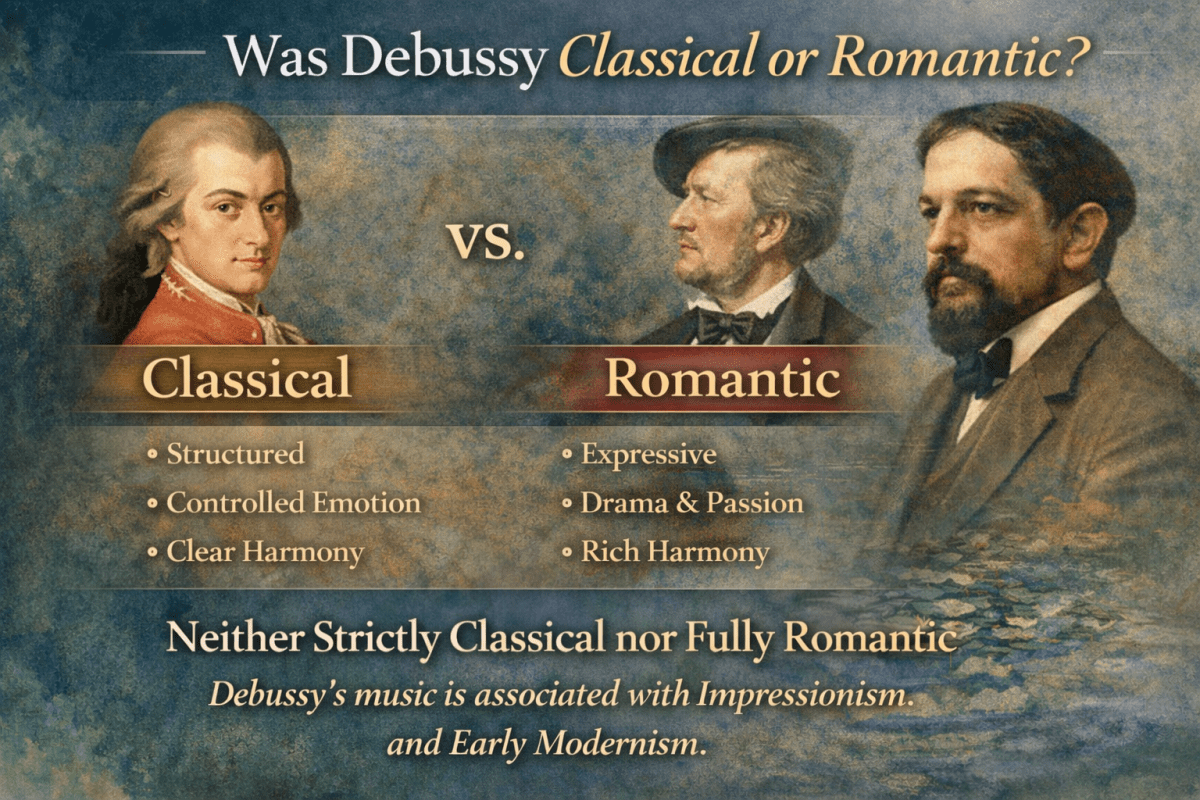
A Bridge Between Romanticism and Modernism
Debussy stood at a crossroads.
He was not fully Romantic. He was not fully Modern.
He was transitional — a bridge between two eras.
- He kept Romantic sensitivity and lyricism.
- He introduced Modern harmonic ambiguity and structural freedom.
- His innovations influenced 20th-century composers like Ravel, Stravinsky, and Bartók.
According to musicologist Richard Taruskin, Debussy’s break from traditional tonality was one of the most significant moments in Western music history.
Debussy and the Impressionist Movement
The term ‘Impressionism’ in music was borrowed from painting.
Artists like Monet and Renoir painted light, water, and atmosphere — not photographic detail.
Debussy did the same in sound.
He was friends with Symbolist poets like Stéphane Mallarmé. He admired artists like Turner and Hokusai.
These influences shaped his entire compositional philosophy.
The Musical Characteristics of Claude Debussy
Debussy’s music has a unique fingerprint. Once you know what to listen for, you will always recognize it.
Here are the seven core musical characteristics that define his style.
1. Emphasis on Tone Color (Timbre)
Debussy treated instruments like a painter treats colors.
For him, how a note sounded was just as important as what note was played.
- He blended orchestral sounds to create shimmering textures.
- He avoided strong melodic dominance.
- He focused on the overall atmosphere of sound.
In his orchestral works, individual instruments emerge and recede like brushstrokes on a canvas.
The flute, harp, and muted strings were favorites — instruments that produce delicate, nuanced tone colors.
This approach was revolutionary. Before Debussy, composers used instruments primarily to project melody or harmony. Debussy used them to paint.
2. Use of Unconventional Scales
Traditional Western music relied on major and minor scales.
Debussy largely abandoned these in favor of more exotic options.
- Whole-tone scales — Six equal tones with no leading note, creating a floating, unresolved sound.
- Pentatonic scales — Five-note scales drawn from Asian musical traditions, evoking simplicity and openness.
- Modal scales — Medieval church modes, giving music an ancient or otherworldly quality.
These scale choices gave Debussy’s music its dreamy, suspended quality.
There is no sense of rushing toward a destination. The music simply exists — like mist over water.
Musicologist Bryan White notes that Debussy’s use of non-functional tonality was a direct departure from the German tonal tradition.
3. Harmonic Innovation
Debussy’s harmony was unlike anything heard before in Western classical music.
Traditional harmony works like grammar — chords have rules, expectations, and resolutions.
Debussy threw out the rulebook.
- He used parallel chord movement — chords moving in the same direction simultaneously.
- He avoided tonal resolution — the expected ‘landing’ at the end of a phrase.
- He used chords for color rather than function.
- He embraced ambiguous tonality — music that never quite settles in one key.
This was shocking to audiences and critics in the early 1900s.
Today, it sounds natural and beautiful — because Debussy’s innovations became part of our musical vocabulary.
Jazz musicians, film composers, and contemporary artists still draw from Debussy’s harmonic language.
4. Fluid Rhythm and Tempo
Classical music has a pulse. You can feel it. You can tap your foot to it.
Debussy’s music resists that.
- His rhythm is flexible — it ebbs and flows.
- He avoids strong rhythmic drive or momentum.
- Musical phrases move like waves — rising and falling.
This fluidity was intentional.
Debussy wanted music to feel like a natural phenomenon — like water, wind, or light — not a mechanical process.
His tempo markings often use poetic language rather than strict metronome numbers: ‘comme une lointaine sonnerie de cors’ (‘like a distant horn call’).
5. Atmospheric and Evocative Style
Debussy’s music is rarely about a story.
It is about a sensation.
- Music suggests moods rather than stating them directly.
- Titles reference nature, poetry, and visual art.
- The listener fills in meaning themselves.
Works like La Mer (The Sea), Jardins sous la pluie (Gardens in the Rain), and Voiles (Sails/Veils) all invoke natural imagery.
But the music never literally depicts these things. It evokes them.
This aligns with Symbolist poetry — a movement Debussy admired — which used language to suggest meaning rather than state it plainly.
6. Avoidance of Traditional Forms
Classical and Romantic composers followed established forms.
Sonata form. Rondo form. Theme and variations. These were the accepted blueprints.
Debussy ignored them.
- His music follows its own internal logic.
- Structure emerges organically from the material.
- There is no formulaic development or recapitulation.
This was not laziness or ignorance. Debussy was highly educated at the Paris Conservatoire.
It was a deliberate artistic choice — to let the music breathe and find its own shape.
7. Influence of Non-Western Music
A turning point came at the 1889 Paris World Exposition.
Debussy heard Javanese gamelan music for the first time.
It changed him profoundly.
- The gamelan used scales and timbres entirely foreign to Western music.
- It had no dominant-tonic harmonic structure.
- It prioritized texture and timbre over melody.
These qualities directly influenced Debussy’s compositional thinking.
He later said the gamelan contained more counterpoint than anything in the Paris Conservatoire textbooks.
Emotional Characteristics of Debussy’s Music

Beyond technique, Debussy’s music has a distinctive emotional character.
Understanding this helps listeners connect more deeply with his works.
- Subtlety over drama — Emotion is suggested, not announced.
- Sensory immersion — The music appeals to the senses like a physical experience.
- Ambiguity — Feelings are layered and complex, not simple.
- Introspection — The music invites quiet reflection.
- Beauty for its own sake — Sound is treated as inherently valuable, not as a vehicle for narrative.
Debussy once said: ‘Music is the silence between the notes.’ This captures his philosophy perfectly.
What is not played is as important as what is.
His music trusts the listener. It does not explain itself. It does not ask for a response. It simply exists, fully formed, in sound and silence.
Key Works That Showcase Debussy’s Characteristics
The best way to understand Debussy is to listen. Here are five essential works — with what to listen for in each.
Clair de Lune (1905)
From the Suite bergamasque for solo piano.
This is Debussy’s most beloved and recognized piece.
- Listen for: Soft, blended textures that shimmer like moonlight on water.
- Characteristic shown: Tone color and atmospheric evocation.
- The melody floats above rippling arpeggios, never asserting itself too strongly.
Clair de Lune has been used in films, advertisements, and wedding ceremonies worldwide — a testament to its universal emotional appeal.
Prélude à l’après-midi d’un faune (1894)
Prelude to the Afternoon of a Faun — for orchestra.
Widely considered the first truly Impressionist orchestral work.
- Listen for: The opening solo flute melody — sensuous, wandering, unresolved.
- Characteristic shown: Harmonic ambiguity and fluid rhythm.
- The whole-tone scale appears throughout, giving the piece its hazy, dreamlike quality.
Igor Stravinsky called this piece ‘the beginning of modern music.’
La Mer (1905)
The Sea — a symphonic poem in three movements.
Debussy’s most ambitious orchestral work.
- Listen for: The orchestra becomes the sea — surging, retreating, shimmering.
- Characteristic shown: Tone painting and avoidance of traditional form.
- There is no story. There is only the experience of the sea.
La Mer was initially criticized for being formless. Today it is considered a masterpiece of orchestral composition.
Arabesque No. 1 (1891)
A short, flowing piano piece — one of Debussy’s earliest successes.
- Listen for: Delicate, interlocking melodic lines that feel improvisatory.
- Characteristic shown: Fluid rhythm and pentatonic scale influence.
- The piece never feels hurried. It moves like a gentle stream.
Arabesque No. 1 is an ideal starting point for listeners new to Debussy.
Voiles (1910)
From the first book of Préludes for piano.
The title means both ‘Sails’ and ‘Veils’ in French — deliberately ambiguous.
- Listen for: Almost exclusive use of the whole-tone scale throughout.
- Characteristic shown: Unconventional scales and harmonic ambiguity.
- The music floats without resolution, like a sail on still water.
This piece is a perfect demonstration of how Debussy used scale choice as an expressive tool.
String Quartet in G minor (1893)
One of his most formally structured works — yet still distinctly Debussian.
- Listen for: Modal harmonies and unusual textural blends between the four instruments.
- Characteristic shown: Tone color applied to chamber music.
Even within the constraints of the string quartet form, Debussy found ways to innovate.
Debussy’s Influence on Music History
Debussy’s impact did not end with his death in 1918.
His innovations rippled outward — into jazz, film music, contemporary classical music, and beyond.
Influence on Classical Composers
- Maurice Ravel — Deeply influenced by Debussy’s harmonic language and orchestral color.
- Igor Stravinsky — Acknowledged Debussy as a formative influence on his early style.
- Béla Bartók — Incorporated Debussy’s modal harmonies into his Hungarian folk-influenced style.
- Olivier Messiaen — Extended Debussy’s use of color and unconventional scales.
Ravel and Debussy are often grouped together as ‘Impressionist composers,’ though Ravel himself resisted this label.
Influence on Jazz
Debussy’s harmonic innovations had a profound impact on jazz.
- Bill Evans — The jazz pianist drew directly from Debussy’s use of chord voicings and ambiguity.
- Miles Davis — Albums like Kind of Blue (1959) reflect Debussy’s influence through modal jazz.
- Duke Ellington — Acknowledged Debussy as an influence on his orchestration.
The connection between Debussy and jazz is well documented. Both prioritize timbre, mood, and harmonic color over rigid structure.
Influence on Film Music
Film composers have borrowed heavily from Debussy.
His techniques for evoking atmosphere and emotion without explicit narrative were perfectly suited to cinema.
- John Williams, Ennio Morricone, and Hans Zimmer have all cited Impressionist techniques in their work.
- The use of leitmotifs and tone painting in film scores owes much to Debussy’s innovations.
Influence on Pop and Contemporary Music
Debussy’s reach extends even into popular music.
- Brian Eno’s ambient music draws on Debussy’s concept of music as atmosphere.
- The band Radiohead has cited Debussy’s harmonic language as an influence.
- Contemporary classical composers like Arvo Pärt and Max Richter continue to work in the atmospheric tradition Debussy established.
How Debussy Differed from Other Composers
Comparing Debussy to his contemporaries clarifies what made him unique.
Debussy vs. Wagner
- Wagner: Grand, emotional, narrative-driven, tonal.
- Debussy: Subtle, suggestive, atmospheric, tonally ambiguous.
Debussy initially admired Wagner but later rejected his influence deliberately, seeking a distinctly French musical identity.
Debussy vs. Brahms
- Brahms: Structured, formal, rooted in Classical tradition.
- Debussy: Free-form, organic, anti-structural.
Where Brahms perfected inherited forms, Debussy dismantled them.
Debussy vs. Ravel
- Both used similar harmonic language.
- Ravel was more formally structured and precise.
- Debussy was more spontaneous and atmospheric.
Ravel himself said: ‘Debussy’s music is like a landscape seen through fog. Mine is the same landscape in clear light.’
Criticisms and Controversies
Not everyone loved Debussy’s innovations.
At the Paris Conservatoire, his unconventional harmonies repeatedly earned him failing grades.
- Critics called his music ‘formless.’
- Some called it ‘mere impressionism’ — intended as an insult.
- His debut orchestral work, La Mer, received mixed reviews.
One critic wrote that Debussy was ‘painting the sea without getting his feet wet.’
Debussy was unbothered. He continued to follow his own artistic vision.
History vindicated him. Works once called formless are now studied in music conservatories worldwide.
Conclusion: Why Debussy Still Matters
Claude Debussy was not just a composer.
He was a revolutionary.
He looked at 300 years of Western musical tradition and asked: What if we tried something different?
The answer was Impressionism — a style that prioritized atmosphere over argument, color over structure, sensation over narrative.
His key characteristics — atmospheric style, harmonic innovation, tone color focus, fluid rhythm, and unconventional scales — were not mere stylistic choices.
They were a complete reimagining of what music could be.
And that reimagining changed everything.
- He gave classical music a new emotional vocabulary.
- He opened the door to Modernism.
- He influenced jazz, film music, ambient music, and contemporary classical composition.
- He showed that music could suggest without stating, evoke without explaining.
More than 100 years after his death, Clair de Lune still moves people to tears.
La Mer still sounds like the sea.
And Prélude à l’après-midi d’un faune still sounds like a dream that has not quite ended.
That is the power of Debussy’s characteristics. They were not just innovations. They were discoveries — about sound, about beauty, about what music can do to the human heart.
Resources
🔗 Debussy, Claude — Grove Music Online (Oxford Music Online)
🔗 Impressionism in Music — Encyclopaedia Britannica
🔗 Claude Debussy — Biography, Music & Facts — Encyclopaedia Britannica
🔗 Debussy: Clair de Lune Analysis — Music Theory.net
🔗 Claude Debussy — The Kennedy Center
🔗 Prélude à l’après-midi d’un faune — Analysis — JSTOR
🔗 Debussy and the Gamelan — Stanford Encyclopedia of Music
🔗 Debussy’s Harmonic Language — Journal of Music Theory (Yale)
🔗 Whole-Tone Scale in Debussy — Music Theory Spectrum (Oxford)
🔗 Debussy’s Influence on Jazz — Jazz Education Network

Dan Palmer is a dedicated academic writing specialist with extensive experience supporting nursing students throughout their educational journey. Understanding the unique challenges faced by nursing students who balance demanding clinical rotations, family responsibilities, and rigorous coursework, Dan provides professional assignment assistance that helps students maintain academic excellence without compromising their other commitments.
With a comprehensive understanding of nursing curriculum requirements and academic standards, Dan delivers high-quality, thoroughly researched assignments that serve as valuable learning resources. His expertise spans various nursing disciplines, including clinical practice, healthcare ethics, patient care management, and evidence-based research.
Dan’s approach combines meticulous attention to detail with a commitment to timely delivery, ensuring that busy nursing students receive the support they need when they need it most. His professional assistance has helped countless nursing students successfully navigate their academic programs while maintaining their professional and personal responsibilities.
Committed to academic integrity and excellence, Dan Palmer continues to be a trusted resource for nursing students seeking reliable, professional assignment support.