
Was Debussy Classical or Romantic?
Was Debussy Classical or Romantic? A Clear Answer
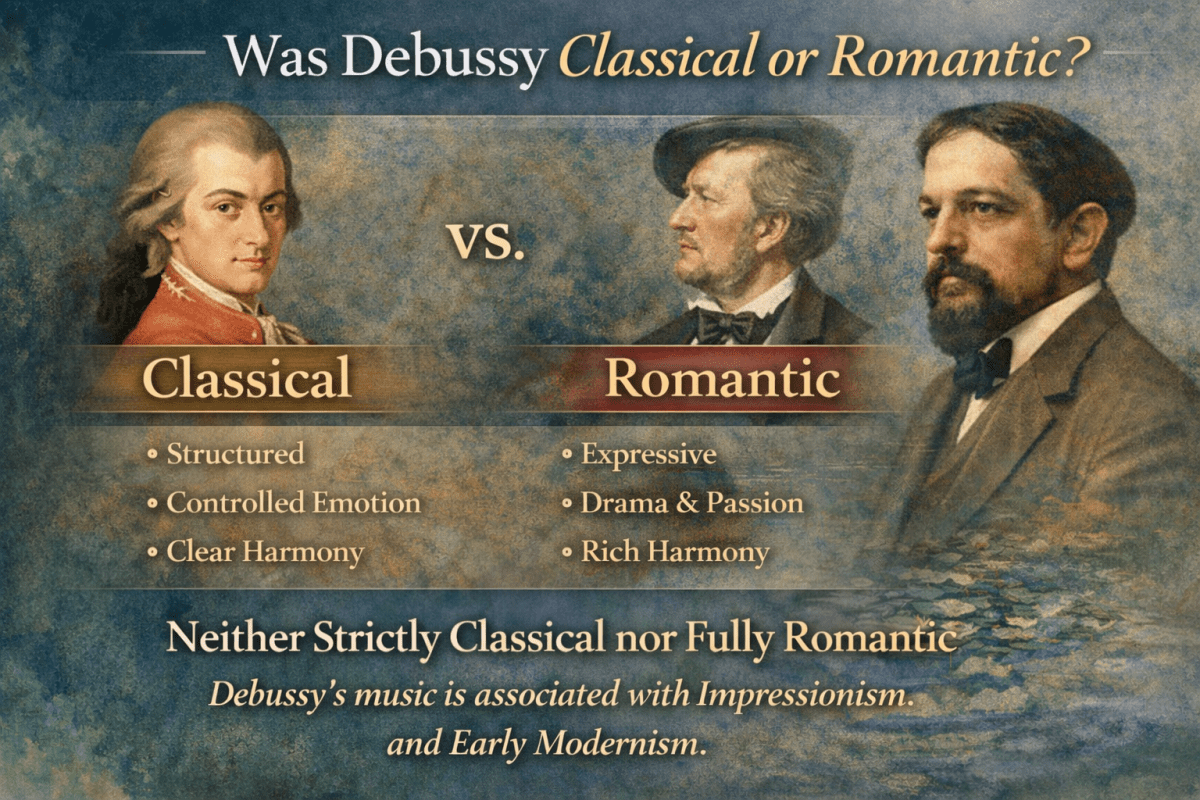
Claude Debussy (1862–1918) was neither a Classical composer nor a purely Romantic composer. Although he lived during the late Romantic period, his musical style broke away from Romantic traditions and helped establish Impressionism in music. For this reason, music historians generally classify him as an Impressionist and early Modernist composer rather than Classical or Romantic.
To understand why, we must first explore what “Classical” and “Romantic” actually mean in music history.
Understanding the Classical Period (1750–1820)
The Classical period in Western music roughly spans from 1750 to 1820. This era followed the Baroque period and emphasized clarity, balance, and structural precision.
Key Characteristics of Classical Music
-
Formal Structure
-
Sonata form
-
Symphony structure
-
String quartets
-
Clear movement organization
-
-
Balance and Symmetry
-
Even phrasing
-
Logical development
-
Predictable harmonic progressions
-
-
Clear Tonality
-
Strong sense of key
-
Functional harmony
-
Clear resolutions
-
-
Moderate Emotional Expression
-
Expressive but controlled
-
Avoided extremes of drama
-
Major Classical Composers
-
Wolfgang Amadeus Mozart
-
Joseph Haydn
-
Ludwig van Beethoven (early works)
These composers focused on structural clarity and formal discipline. Music from this period often feels orderly, proportioned, and architecturally sound.
Why Debussy Was Not a Classical Composer

Debussy was born in 1862—more than 40 years after the Classical period ended. Historically, he cannot be categorized as Classical because he did not live or compose during that era.
Stylistically, his music does not reflect Classical balance and formal rigidity. Instead, it often avoids traditional sonata forms, blurs harmonic resolution, and emphasizes color over structure.
Therefore, Debussy was not a Classical composer either chronologically or stylistically.
Understanding the Romantic Period (1820–1900)
The Romantic period followed the Classical era and placed greater emphasis on emotional intensity, individuality, and expanded musical expression.
Key Characteristics of Romantic Music
-
Emotional Expression
-
Passion
-
Drama
-
Personal storytelling
-
-
Expanded Orchestra
-
Larger ensembles
-
Richer timbres
-
Greater dynamic contrast
-
-
Chromatic Harmony
-
Increased use of accidentals
-
Complex harmonic progressions
-
-
Programmatic Music
-
Music that tells a story
-
Inspired by literature, art, and nature
-
-
Virtuosic Performance
-
Technically demanding works
-
Dramatic solo passages
-
Major Romantic Composers
-
Frédéric Chopin
-
Franz Liszt
-
Richard Wagner
-
Pyotr Ilyich Tchaikovsky
-
Johannes Brahms
Romantic music often seeks emotional climax and dramatic storytelling.
Debussy’s Historical Context
Claude Debussy was born in 1862 and died in 1918. This places him firmly within the late Romantic era historically. However, his compositional style diverged from the Romantic aesthetic.
While Debussy was influenced by Romantic composers—particularly Wagner—he ultimately rejected the heavy emotionalism and dramatic intensity typical of Romantic music.
This is where the confusion arises: Debussy lived during the Romantic period, but his style moved beyond it.
Why Debussy Was Not Fully Romantic

Although Debussy composed during the Romantic era, his musical language differed significantly from that of his Romantic predecessors.
1. Rejection of Dramatic Climaxes
Romantic composers often built their music toward grand emotional climaxes. Debussy avoided this dramatic buildup. Instead, his music flows organically, often without obvious peaks or explosive endings.
2. Avoidance of Heavy Harmonic Tension
Romantic music thrives on tension and resolution. Debussy frequently blurred harmonic direction, creating ambiguity rather than clear resolution.
3. Subtle Emotional Atmosphere
Instead of intense passion, Debussy preferred:
-
Suggestion over declaration
-
Atmosphere over drama
-
Mood over narrative
4. New Scales and Harmonic Language
Debussy used:
-
Whole-tone scales
-
Pentatonic scales
-
Modal harmonies
-
Parallel chord motion
These elements differ sharply from Romantic harmonic practices.
Debussy and Impressionism
Debussy is most commonly associated with Impressionism in music.
What Is Impressionism?
Impressionism originated in late 19th-century French painting. Artists like Claude Monet focused on:
-
Light and color
-
Fleeting moments
-
Atmospheric effects
-
Sensory impressions
Rather than precise details, Impressionist art captured mood and perception.
Impressionism in Music
In music, Impressionism emphasizes:
-
Tone color (timbre)
-
Fluid rhythms
-
Ambiguous harmony
-
Subtle dynamics
-
Evocative imagery
Debussy’s music mirrors these characteristics.
Musical Techniques That Define Debussy’s Style
1. Whole-Tone Scales
These scales eliminate the traditional sense of tonal gravity, creating floating, dreamlike sounds.
2. Pentatonic Scales
Often associated with Asian musical traditions, these scales produce open, ethereal textures.
3. Parallel Harmony
Debussy frequently moved chords in parallel motion, breaking classical harmonic rules.
4. Ambiguous Tonality
Rather than establishing a firm key center, Debussy often obscured tonal direction.
5. Orchestral Color
He treated the orchestra like a painter’s palette, blending instrumental timbres to create atmospheric effects.
Famous Works That Demonstrate His Style
Clair de Lune
-
Soft, flowing piano textures
-
Emphasis on mood
-
Delicate harmonic shifts
Prélude à l’après-midi d’un faune
-
Inspired by poetry
-
Sensual orchestration
-
Fluid melodic lines
La Mer
-
Orchestral depiction of the sea
-
Shimmering textures
-
Evocative imagery
These works clearly show his departure from Romantic intensity.
Did Debussy Accept the Label “Impressionism”?
Interestingly, Debussy himself disliked the term “Impressionism.” He believed critics misapplied the label to his music.
However, despite his objections, music historians continue to classify him as Impressionist because of the stylistic similarities between his work and Impressionist art.
Debussy as an Early Modernist
Many scholars also consider Debussy an early Modernist composer.
Why?
-
He challenged traditional harmony.
-
He experimented with form.
-
He influenced 20th-century composers like Ravel and Stravinsky.
Modernism in music sought innovation, and Debussy helped initiate that shift.
Comparing Debussy to Classical and Romantic Composers
| Feature | Classical | Romantic | Debussy |
|---|---|---|---|
| Structure | Strict forms | Expanded forms | Flexible forms |
| Harmony | Clear resolution | Chromatic tension | Ambiguous tonality |
| Emotion | Controlled | Dramatic | Atmospheric |
| Orchestration | Balanced | Expansive | Color-focused |
This comparison highlights why Debussy does not fit comfortably into either Classical or Romantic categories.
Why Students Get Confused
-
He lived during the Romantic era.
-
He was influenced by Romantic composers.
-
His music still contains expressive elements.
However, influence does not equal classification.
How to Answer This Question in Exams
If asked:
Was Debussy Classical or Romantic?
You should respond:
Claude Debussy was neither strictly Classical nor fully Romantic. Although he lived during the Romantic period, his innovative harmonic language and emphasis on atmosphere align him more closely with Impressionism and early Modernism.
Keep your answer concise, historically accurate, and stylistically clear.
Debussy’s Lasting Influence
Debussy changed the course of music history.
His innovations influenced:
-
Maurice Ravel
-
Igor Stravinsky
-
Béla Bartók
-
Modern film composers
His exploration of tone color paved the way for new musical languages in the 20th century.
Final Conclusion
Claude Debussy was not a Classical composer. Although he lived during the Romantic era, he did not fully embrace Romantic drama or harmonic conventions. Instead, he developed a new musical language that emphasized color, atmosphere, and subtle expression.
For this reason, Debussy is best described as an Impressionist and early Modernist composer.
Understanding his position between Romanticism and Modernism helps clarify his revolutionary role in shaping the future of Western music.
References
Brown, M. T. (2023). Debussy and the transformation of late Romantic harmony. Journal of Musicology Research, 41(2), 145–168. https://doi.org/10.1080/01411896.2023.XXXXXX
Burkholder, J. P., Grout, D. J., & Palisca, C. V. (2019). A history of Western music (10th ed.). W. W. Norton & Company. https://wwnorton.com/books/9780393668177
Cook, N. (2018). The Cambridge history of twentieth-century music. Cambridge University Press. https://doi.org/10.1017/CHOL9780521662569
Lockspeiser, E. (2019). Debussy: His life and mind (Revised ed.). Cambridge University Press. https://www.cambridge.org/core/books/debussy/
Parks, R. (2021). Impressionism and symbolism in Debussy’s orchestral works. Music Theory Spectrum, 43(1), 75–98. https://doi.org/10.1093/mts/mtaa039
Taruskin, R. (2020). Music in the early twentieth century. Oxford University Press. https://global.oup.com/academic/product/music-in-the-early-twentieth-century-9780195384847
Trezise, S. (Ed.). (2003). The Cambridge companion to Debussy. Cambridge University Press. https://doi.org/10.1017/CCOL9780521654786

Dan Palmer is a dedicated academic writing specialist with extensive experience supporting nursing students throughout their educational journey. Understanding the unique challenges faced by nursing students who balance demanding clinical rotations, family responsibilities, and rigorous coursework, Dan provides professional assignment assistance that helps students maintain academic excellence without compromising their other commitments.
With a comprehensive understanding of nursing curriculum requirements and academic standards, Dan delivers high-quality, thoroughly researched assignments that serve as valuable learning resources. His expertise spans various nursing disciplines, including clinical practice, healthcare ethics, patient care management, and evidence-based research.
Dan’s approach combines meticulous attention to detail with a commitment to timely delivery, ensuring that busy nursing students receive the support they need when they need it most. His professional assistance has helped countless nursing students successfully navigate their academic programs while maintaining their professional and personal responsibilities.
Committed to academic integrity and excellence, Dan Palmer continues to be a trusted resource for nursing students seeking reliable, professional assignment support.