
Claude Debussy and Musical Impressionism: A Comprehensive Guide
Claude Debussy and Musical Impressionism
Introduction: What Kind of Music Was Debussy Associated With?
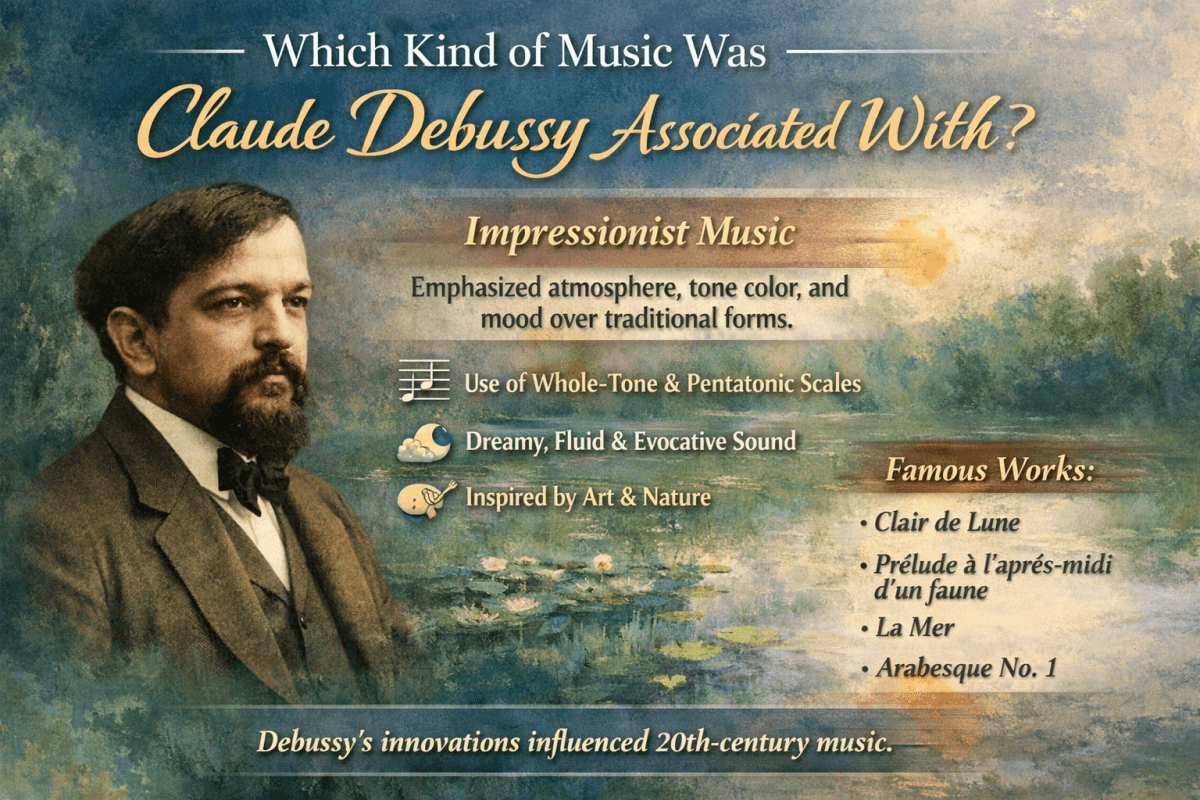
Claude Debussy (1862–1918) is almost universally associated with musical Impressionism — a style that sought to evoke mood, atmosphere, and sensation rather than follow the strict structural conventions of the Romantic tradition. Yet calling Debussy simply an “Impressionist” is both accurate and incomplete. He himself actively resisted the label, preferring to think of himself as a composer pursuing beauty in new and entirely personal ways.
This article explores what kind of music Debussy was associated with, what musical Impressionism actually means in technical terms, how Debussy arrived at his distinctive sound, and why his work continues to resonate in concert halls, film scores, and music classrooms around the world.
| Category | Details |
| Primary Genre | Musical Impressionism |
| Era | Late Romantic / Early Modern (1880s–1918) |
| Nationality | French |
| Key Works | Clair de lune, La Mer, Prelude to the Afternoon of a Faun |
| Influenced By | Symbolist poetry, Javanese gamelan, Russian Nationalism |
| Influenced | Ravel, Stravinsky, Satie, Schoenberg, jazz |
| “I am trying to do something different — in a way realities — what the imbeciles call impressionism is a term which is as poorly used as possible.” — Claude Debussy |
1. Musical Impressionism: The Core Concept
What Is Musical Impressionism?
Musical Impressionism is a style that emerged in France in the late 19th century. Like its visual counterpart in painting — associated with Claude Monet, Edgar Degas, and Camille Pissarro — musical Impressionism is concerned less with the clear definition of structure and more with capturing fleeting sensory impressions, moods, and atmospheres.
Where Romantic composers such as Brahms or Beethoven built music around strong themes, dramatic development, and clear harmonic resolution, Impressionist music tends to blur these distinctions. Melodies become fragmentary and suggestive. Harmonies drift and shimmer without resolving in traditional ways. Rhythm becomes fluid and unpredictable. The overall effect is often described as dreamlike, sensory, or painterly.
Impressionism vs. Romanticism: Key Differences
| Feature | Romanticism | Impressionism |
| Harmonic language | Functional, goal-directed | Non-functional, color-based |
| Melody | Long, singable, expressive | Short, fragmentary, suggestive |
| Structure | Sonata, symphony, concerto | Looser, atmospheric, through-composed |
| Emotional expression | Overt, dramatic | Subtle, evocative |
| Key examples | Brahms, Wagner, Liszt | Debussy, early Ravel |
2. Debussy’s Musical Language: Technical Terms Explained
One of the reasons Debussy’s music sounds so distinctive is that he developed an entirely new harmonic and textural language. Understanding the technical concepts behind his music helps explain why it evokes such specific sensory experiences.
Whole-Tone Scale
One of Debussy’s most recognizable tools is the whole-tone scale — a six-note scale in which every adjacent note is separated by a whole step (unlike the standard major or minor scale, which alternates whole and half steps). This scale has no natural leading tone, so it creates no sense of harmonic tension or resolution. Music built on whole-tone scales drifts and floats, creating a sense of weightlessness or ambiguity — perfectly suited to Impressionist imagery.
Non-Functional Harmony and Parallel Chords
Traditional Western harmony uses chords in sequences that create tension and resolution — the so-called functional harmony of the common practice period. Debussy systematically abandoned this. He used chords not for their function in a harmonic progression but for their color and texture. One of his most famous techniques is the use of parallel chord motion — moving the same chord shape up and down in parallel across the keyboard — which produces the shimmering, iridescent quality so central to pieces like the Preludes and La Mer.
Chromaticism
Debussy’s music employs chromaticism — the use of notes outside the standard diatonic scale — to enrich texture and blur tonality. This was not unique to Debussy (Wagner was highly chromatic), but Debussy used chromaticism in new ways, often not to intensify drama but to dissolve structure and increase atmospheric ambiguity.
Pentatonic and Modal Scales
After hearing Javanese gamelan music at the 1889 Paris Exposition Universelle, Debussy became fascinated with pentatonic scales (five-note scales common in East Asian music) and church modes (medieval scale patterns that predated major/minor tonality). Both produced sounds outside the Western Romantic mainstream and enriched his harmonic palette significantly.
Timbre and Orchestral Color
Debussy was a master of orchestration — the art of combining and blending instrument timbres. In works like La Mer and the Nocturnes, he uses the orchestra not to create power and drama (as Wagner did) but to create color, texture, and atmosphere. He pioneered the use of muted strings, sul ponticello (bowing near the bridge for an ethereal tone), flutter-tongue flute, and delicate percussion blends that would influence 20th-century orchestration profoundly.
Technical Terms Reference Table
| Term | Definition | How Debussy Used It |
| Whole-tone scale | Six-note scale with equal whole steps throughout | To create weightlessness, ambiguity, dreamlike quality |
| Chromaticism | Use of notes outside the key’s diatonic scale | To blur tonality and add harmonic richness |
| Parallel chords | Same chord shape moved in parallel motion | To create shimmering, iridescent sound textures |
| Pentatonic scale | Five-note scale common in East Asian music | Absorbed from gamelan, used for exotic color |
| Modal harmony | Use of pre-tonal church modes | To escape major/minor tonal system |
| Timbre | The tonal color/quality of a sound or instrument | Central to his orchestral and piano writing |
| Atonality | Music lacking a tonal center or key | Debussy approached but did not fully embrace |
| Non-functional harmony | Chords used for color, not structural function | Core of his harmonic language |
| Pizzicato | Plucking string instruments | Used for textural variety in orchestral works |
3. How Debussy Arrived at His Sound: Influences and Biography

Early Life and the Paris Conservatoire
Achille-Claude Debussy was born on August 22, 1862, in Saint-Germain-en-Laye, near Paris, to a family with no strong musical background. He entered the Paris Conservatoire at the age of ten and showed immediate gifts, though his teachers frequently criticized his unconventional approach to harmony. Despite their reservations, he won the prestigious Prix de Rome in 1884 with his cantata L’Enfant prodigue, earning him a residency in Rome.
Russian Music and Nadezhda von Meck
As a young man, Debussy spent summers in Florence, Vienna, and Russia as the personal pianist for Nadezhda von Meck — the wealthy patron who had also supported Tchaikovsky. Through her household, Debussy was introduced to Russian nationalist composers including Borodin, Mussorgsky, and Rimsky-Korsakov. Their use of folk-derived scales and unconventional harmonies had a lasting influence on his developing style, offering him models for escaping German Romantic conventions.
The 1889 Paris Exposition and Gamelan Music
Perhaps no single event influenced Debussy’s musical language more than his attendance at the 1889 Paris Exposition Universelle, where he heard Javanese gamelan music for the first time. The gamelan — a traditional ensemble of percussive instruments including metallophones, gongs, and drums — used pentatonic scales, interlocking rhythmic patterns, and a shimmering, layered texture utterly unlike anything in the Western classical tradition. Debussy was transfixed, and traces of the gamelan’s sound can be heard throughout his piano music, particularly in pieces like Pagodes from Estampes.
Symbolist Poetry and the Arts
Debussy moved in literary as well as musical circles, and his friendships with Symbolist poets — particularly Stephane Mallarme — shaped his aesthetic deeply. Symbolism as a literary movement rejected direct statement and narrative in favor of suggestion, evocation, and the use of images to convey emotional and sensory experience. This philosophy maps directly onto Debussy’s musical approach: rather than stating a theme and developing it, he evokes a mood and lets it shimmer and change.
His breakthrough orchestral work, Prelude to the Afternoon of a Faun (1894), was directly inspired by Mallarme’s poem “L’Apres-midi d’un faune” and is widely considered the first major work of musical Impressionism.
Debussy’s Rejection of Wagner
By the 1890s, Richard Wagner’s operatic style dominated European classical music. His densely chromatic harmony, enormous orchestral forces, and through-composed “music dramas” were seen by many as the peak of Western musical achievement. Debussy had initially admired Wagner — he attended the Bayreuth Festival in 1888 and 1889 — but gradually came to see Wagnerism as a creative dead end for French music. He spent much of his career actively working against Wagnerian influence, developing instead a French aesthetic of clarity, sensory delicacy, and restraint.
4. Debussy’s Major Works: A Listener’s Guide
| Work | Year | Medium | Notable For |
| Prelude to the Afternoon of a Faun | 1894 | Orchestra | First landmark of musical Impressionism; inspired by Mallarme |
| String Quartet in G minor | 1893 | Chamber music | Shows Impressionist textures in intimate form |
| Pelleas et Melisande | 1902 | Opera | Debussy’s only completed opera; radical restraint |
| Estampes | 1903 | Piano | Includes Pagodes, showing gamelan influence |
| La Mer | 1905 | Orchestra | “Three symphonic sketches”; his orchestral masterpiece |
| Images (Books I & II) | 1905-07 | Piano | Includes Reflets dans l’eau and Golliwog’s Cakewalk |
| Children’s Corner | 1908 | Piano | Dedicated to his daughter; includes Doctor Gradus |
| Preludes (Books I & II) | 1909-13 | Piano | Includes La Cathedrale engloutie and La Fille aux cheveux de lin |
| Clair de lune | 1905 (Suite bergamasque) | Piano | His most famous single piece; published as part of larger suite |
| Jeux | 1913 | Ballet/Orchestra | Final major orchestral work; radical modernism |
Composers and Musical Contemporaries Associated with Debussy
- Maurice Ravel — French contemporary and fellow Impressionist; their relationship was complex, as both were independently developing similar styles
- Erik Satie — Eccentric French avant-gardist and friend; Satie’s spare, unconventional style pre-dated and influenced Debussy’s harmonic thinking
- Igor Stravinsky — Russian modernist who admired and was influenced by Debussy; they met in Paris in the 1910s
- Arnold Schoenberg — Austrian composer whose atonal movement ran parallel to Debussy’s harmonic experiments
- Gabriel Faure — French Romantic composer and Debussy’s predecessor at the Paris Conservatoire
- Paul Dukas — French composer and colleague, best known for The Sorcerer’s Apprentice
- Edgard Varese — Radical modernist who credited Debussy as a major influence
- Richard Wagner — German opera composer whose dominance Debussy reacted against
Literary and Artistic Figures Associated with Debussy
- Stephane Mallarme — Symbolist poet whose poem inspired Prelude to the Afternoon of a Faun
- Edgar Allan Poe — American writer whose work Debussy admired and planned (but failed) to set to music
- Claude Monet — Impressionist painter after whom Debussy’s style is named by analogy
- Paul Verlaine — Symbolist poet whose work Debussy set in his early songs
Key Places Associated with Debussy
- Saint-Germain-en-Laye — Debussy’s birthplace, near Paris
- Paris Conservatoire — Where Debussy trained from age 10; the center of French musical education
- Rome (Villa Medici) — Where Debussy lived after winning the Prix de Rome, 1885-87
- Bayreuth, Germany — Where Debussy attended the Bayreuth Festival in 1888 and 1889
- Eastbourne, England — Where Debussy composed part of La Mer
- Cannes — Where Debussy spent time during his illness in his final years
6. Debussy’s Legacy and Influence
Influence on 20th-Century Classical Music
Debussy’s innovations reshaped the course of Western classical music. By demonstrating that tonal harmony could be dissolved without becoming atonal chaos, he opened a space between Romantic tonality and 20th-century modernism that composers from Ravel to Messiaen explored for decades. His orchestral techniques influenced film scoring, and his piano writing established a new standard for the instrument’s expressive possibilities.
Influence on Jazz
Debussy’s non-functional harmony, his interest in the pentatonic scale, and his use of the blues-adjacent whole-tone scale made his music surprisingly congenial to jazz musicians. Jazz pianists from Bill Evans to Herbie Hancock have cited Debussy as an influence. The lush, chord-rich style of jazz piano that emerged in the mid-20th century owes a structural debt to Debussy’s harmonic language.
Influence on Film Music
The atmospheric, color-focused approach of musical Impressionism proved perfectly suited to cinema. Debussy’s techniques — particularly his use of parallel chords, orchestral shimmer, and modal harmony — became foundational tools for Hollywood film scoring. Composers such as Bernard Herrmann, John Williams, and Hans Zimmer have all drawn on Impressionist techniques rooted in Debussy.
Statistics and Cultural Impact
| Metric | Data |
| Spotify monthly listeners (approx.) | ~2.5 million (Debussy artist profile) |
| Clair de lune — estimated Spotify streams | Over 500 million streams across versions |
| Works in standard repertoire | 100+ piano pieces, 3 orchestral sets, 1 opera, ~60 songs |
| Countries where studied in conservatoire | Virtually all — standard curriculum worldwide |
| Influence ranking (BBC Music Magazine poll) | Top 10 most influential composers of all time |
7. Common Queries Answered
Was Debussy an Impressionist?
Yes — and no. Debussy is universally categorized as the founder and primary exponent of musical Impressionism, and the term accurately describes the atmospheric, sensory quality of his music. However, Debussy himself vehemently rejected the label, associating it with superficiality and careless critical labeling. He preferred to be seen simply as a French musician pursuing beauty on his own terms. Most music historians honor both realities: they use “Impressionism” as a useful stylistic descriptor while acknowledging Debussy transcended any single category.
What Is the Difference Between Debussy and Ravel?
Both composers are labeled Impressionists, and both were French, but their styles differ considerably. Debussy’s music is more fluid, ambiguous, and impressionistic in texture — harmonies and forms are deliberately blurred. Ravel’s music, while similar in surface sound, tends to be more precise in structure, more neoclassical in form, and more mechanically elegant. Ravel himself noted that while Debussy was an Impressionist, he (Ravel) was not.

What Makes Debussy Different from Romantic Composers?
Romantic composers like Brahms, Wagner, and Schumann built music around expressive themes, developmental forms (sonata form, through-composition with clear narrative), and functional harmony in which chords lead logically from tension to resolution. Debussy replaced all of this with a sound-world built on color, texture, and suggestion. He used scales and harmonies that created atmosphere rather than drama, and structures that evoked scenes or sensations rather than told emotional stories.
What Is Clair de Lune and Why Is It Famous?
Clair de lune (“Moonlight”) is the third movement of Debussy’s Suite bergamasque for solo piano, composed around 1890 but published in 1905. It is his single most famous piece and one of the most recognized piano works in the classical repertoire. The piece uses delicate arpeggiated figures, modal harmonies, and a gentle triple meter to evoke the atmosphere of moonlit water — a quintessential example of Impressionist musical imagery. Its accessibility and emotional directness have made it a cultural touchstone, appearing in countless films, advertisements, and popular recordings.
8. Frequently Asked Questions (FAQ)
Q: What musical movement was Claude Debussy associated with?
A: Debussy is primarily associated with musical Impressionism — a late 19th/early 20th century style, especially prominent in France, that uses harmony, texture, and orchestration to evoke mood and atmosphere rather than follow strict classical forms.
Q: What are Claude Debussy’s most famous compositions?
A: His most famous works include Clair de lune (from the Suite bergamasque), Prelude to the Afternoon of a Faun, La Mer, the two books of Preludes for piano, Pelleas et Melisande (opera), Nocturnes, and Estampes.
Q: Did Claude Debussy consider himself an Impressionist?
A: No. Debussy actively rejected the Impressionist label, which he felt was used carelessly and inaccurately. Despite this, music historians continue to use the term because it accurately describes the atmospheric, sensory quality of much of his music.
Q: How did Debussy influence later music?
A: Debussy influenced classical composers (Ravel, Messiaen, Boulez), jazz musicians (Bill Evans, Herbie Hancock), film composers (Bernard Herrmann, John Williams), and rock musicians. His harmonic innovations, particularly his use of non-functional chords and exotic scales, became part of the standard musical vocabulary of the 20th century.
Q: What scales did Debussy use?
A: Debussy used a range of non-standard scales including the whole-tone scale, pentatonic scale, and various church modes. These choices gave his music its distinctive floating, unresolved quality distinct from conventional tonal music.
Q: When did Debussy live?
A: Claude Debussy was born on August 22, 1862, in Saint-Germain-en-Laye, France, and died on March 25, 1918, in Paris, during the German bombing of the city in World War I. He died of rectal cancer at age 55.
Q: Was Debussy influenced by non-Western music?
A: Yes — significantly. Hearing Javanese gamelan music at the 1889 Paris Exposition Universelle was a formative experience. The gamelan’s pentatonic scales, layered textures, and non-Western rhythmic structure influenced many aspects of Debussy’s piano and orchestral writing.
Q: Is Debussy’s music considered classical or modern?
A: Debussy occupies a transitional position between the Romantic era and musical Modernism. His music belongs to the late 19th/early 20th century and is performed in classical concerts, but his harmonic language broke with Romantic tradition and pointed toward the radical innovations of 20th-century Modernism.
Conclusion
Claude Debussy was associated with musical Impressionism — a style he essentially founded but characteristically refused to name. His music marked one of the great turning points in Western music history: the moment when the dense expressivity and harmonic logic of German Romanticism gave way to a new French aesthetic of atmosphere, color, and sensation.
His techniques — the whole-tone scale, parallel chords, non-functional harmony, and extraordinary orchestral color — did not just define a style but created a new vocabulary that composers, jazz musicians, and film scorers have been drawing on ever since. More than a century after his death, Debussy’s music remains a living presence in concert halls and streaming platforms worldwide, as evocative and atmospherically rich as the moonlit water, wind-swept seas, and ancient cathedrals it so hauntingly portrays.
| Whether you encounter Debussy through Clair de lune at a piano recital, La Mer in a concert hall, or his harmonic fingerprints in a film score, you are hearing the music of a composer who fundamentally changed what Western music could sound like — and feel like. |
References and Further Reading
- Lesure, Francois & Nichols, Roger (eds.). Debussy Letters. Harvard University Press, 1987.
- Nichols, Roger. The Life of Debussy. Cambridge University Press, 1998.
- Howat, Roy. The Art of French Piano Music. Yale University Press, 2009.
- Trezise, Simon (ed.). The Cambridge Companion to Debussy. Cambridge University Press, 2003.
- Wheeldon, Marianne. Debussy’s Late Style. Indiana University Press, 2009.
- BBC Music Magazine — “The 50 Greatest Composers of All Time” (various editions).
- Grove Music Online / Oxford Music Online — “Debussy, Claude” (standard musicological reference).
- com — Claude Debussy artist biography and discography.
- Spotify for Artists data — Debussy streaming statistics (accessed 2024).

Dan Palmer is a dedicated academic writing specialist with extensive experience supporting nursing students throughout their educational journey. Understanding the unique challenges faced by nursing students who balance demanding clinical rotations, family responsibilities, and rigorous coursework, Dan provides professional assignment assistance that helps students maintain academic excellence without compromising their other commitments.
With a comprehensive understanding of nursing curriculum requirements and academic standards, Dan delivers high-quality, thoroughly researched assignments that serve as valuable learning resources. His expertise spans various nursing disciplines, including clinical practice, healthcare ethics, patient care management, and evidence-based research.
Dan’s approach combines meticulous attention to detail with a commitment to timely delivery, ensuring that busy nursing students receive the support they need when they need it most. His professional assistance has helped countless nursing students successfully navigate their academic programs while maintaining their professional and personal responsibilities.
Committed to academic integrity and excellence, Dan Palmer continues to be a trusted resource for nursing students seeking reliable, professional assignment support.