
Which Kind of Music Was Claude Debussy Associated With?
Which Kind of Music Was Claude Debussy Associated With?
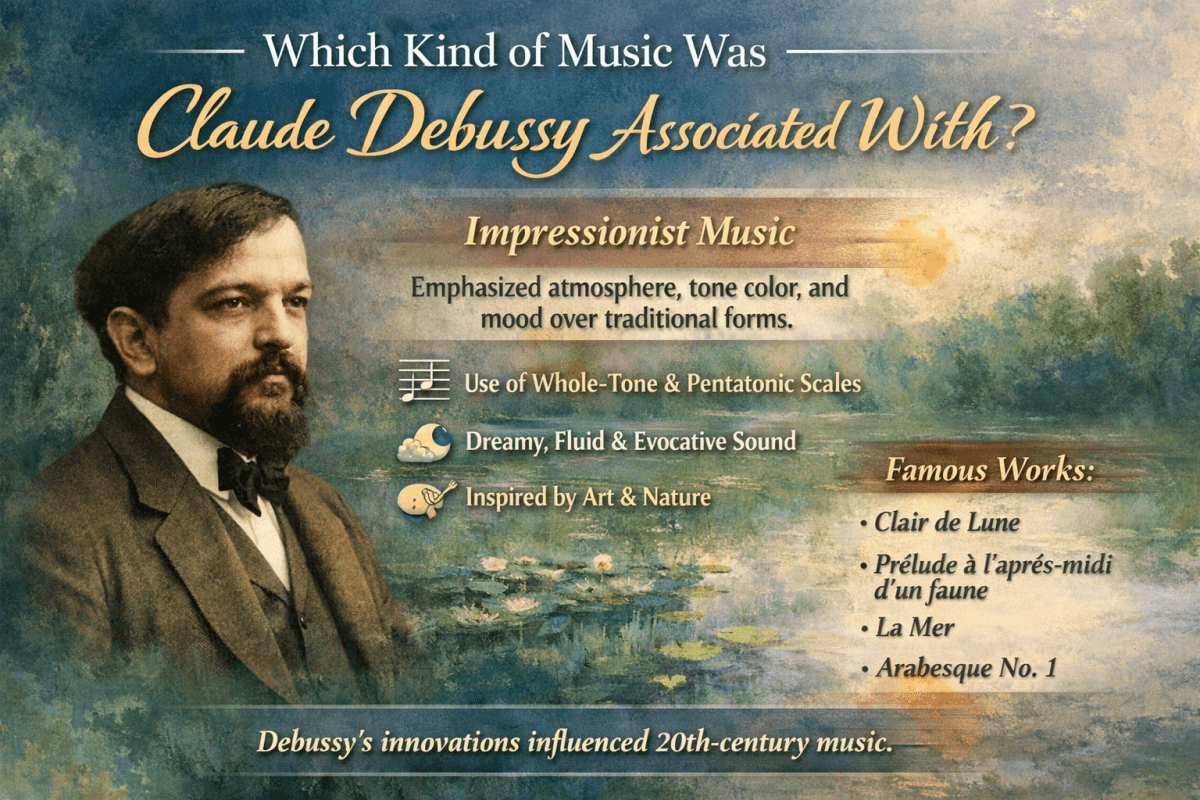
Claude Debussy was primarily associated with Impressionist music. A French composer of remarkable originality, Debussy developed a style that prioritized atmosphere, tone color, and shifting mood over the rigid structural frameworks that had governed Western classical music for centuries. His innovations did not just create a new genre — they fundamentally altered the direction of music in the 20th century and beyond (Wenk, 1976; Lockspeiser, 1962).
II. Brief Background on Claude Debussy
Achille-Claude Debussy was born on August 22, 1862, in Saint-Germain-en-Laye, France, and died on March 25, 1918, in Paris. His life spanned one of the most turbulent and transformative periods in both European history and the history of Western music. He grew up during the height of the Romantic era, a period dominated by composers like Richard Wagner, Johannes Brahms, and Franz Liszt — artists who favored grand emotional gestures, epic orchestral forces, and complex harmonic language rooted in tension and resolution (Trezise, 2003).
Debussy entered the Paris Conservatoire at the age of ten, where he proved to be both a gifted and a troublesome student. Gifted because of his obvious musical instincts and ability; troublesome because he persistently clashed with professors over established rules of harmony and counterpoint. That rebellious spirit would become the engine of his artistic identity (Roberts, 1996).
He won the prestigious Prix de Rome in 1884 with his cantata L’Enfant prodigue, which allowed him to spend time studying in Rome. While there, he encountered the music of Wagner more deeply, and though he was initially drawn to the German master’s innovations in harmony, Debussy ultimately rejected Wagnerian excess as a creative model. He found it too heavy, too dramatic, too calculated — and began searching for something more subtle, more elusive, and ultimately more French (Orledge, 1982).
By the 1890s, Debussy had begun developing a musical language unlike anything heard before. He drew from Javanese gamelan music he encountered at the 1889 Paris World Exposition, from Russian composers like Mussorgsky, and from the French Symbolist poets and Impressionist painters surrounding him in Parisian cultural life (Mueller, 1986). The result was a compositional voice that was entirely his own — and that voice would go on to influence virtually every major composer of the 20th century, from Maurice Ravel to Igor Stravinsky to jazz pioneers like Bill Evans and Miles Davis (Tymoczko, 1997).
III. What Is Impressionism in Music?
To understand why Debussy is called an Impressionist, it helps to understand what Impressionism actually means — first in painting, and then in music. The term “Impressionism” originated in the visual arts, coined somewhat mockingly in response to Claude Monet’s 1872 painting Impression, Sunrise. Impressionist painters like Monet, Edgar Degas, and Camille Pissarro moved away from sharp, defined outlines and precise realistic detail. Instead, they captured the fleeting quality of light, the shimmer of water, the haze of a summer afternoon (Brombert, 2009).
When music critics began applying this term to Debussy’s compositions in the late 19th century, they were drawing a direct analogy. Just as Impressionist painters dissolved firm outlines in favor of atmosphere and suggestion, Debussy dissolved the firm structural expectations of Romantic-era music in favor of mood, texture, and ambiguity (Pasler, 1982). Impressionist music, as exemplified by Debussy, is defined by several key characteristics:
Mood and Atmosphere Over Drama
Where Romantic composers built their works around dramatic arcs — tension rising toward a climax, conflict resolved at the end — Debussy was more interested in evoking a sustained emotional atmosphere. His music does not necessarily go anywhere in the traditional sense. It exists, like a painting hung on a wall, to be experienced and felt rather than followed as a narrative (Howat, 1983).
Tone Color (Timbre) as a Primary Element
In traditional classical music, the melody and harmony were considered the most important elements, with the choice of instrument being secondary. Debussy reversed this hierarchy. How a note sounded — whether plucked, bowed softly, played with a mute, or allowed to decay slowly — was as important to him as what note was played. He was a master orchestrator who used the orchestra not as a vehicle for melody but as a palette of colors (Lesure & Nichols, 1987).
Fluid, Non-Metric Rhythms
Impressionist music tends to avoid strong, regular pulse. Rather than marching forward with rhythmic certainty, it flows and ebbs, drifts and settles. Debussy often blurred the sense of downbeat, letting rhythms float freely in a way that feels organic rather than mechanical (Gillmor, 1988).
Non-Traditional Scales
One of Debussy’s most distinctive technical innovations was his embrace of scales outside the major-minor system that had dominated Western music for centuries. He made extensive use of the whole-tone scale, in which each note is separated by an equal interval of a whole step, creating a dreamlike, unmoored quality with no clear tonal center. He also drew heavily on the pentatonic scale and the ancient church modes, all of which gave his music an exotic, otherworldly quality (Parks, 1989).
Avoidance of Strict Harmonic Resolution
Traditional Western harmony operates on a system of tension and release. Chords build dissonance that demands resolution to consonance — the musical equivalent of a question demanding an answer. Debussy was famously uninterested in this resolution. He allowed chords to hang unresolved, to move in parallel motion (which was long considered a fundamental error), and to succeed one another based on color and sensation rather than functional harmonic logic (McFarland, 2012).
IV. How Debussy’s Music Reflects Impressionism

Understanding the theory is one thing; hearing how Debussy put it into practice is another. His technical innovations produce a genuinely distinctive sonic world that any listener can recognize once they know what to listen for.
The Whole-Tone Scale in Practice
When Debussy uses whole-tone scales, the effect is immediately striking. Because the scale lacks the half-steps that give major and minor scales their sense of direction and gravitational pull, the music seems to hover, untethered. Passages built on this scale often feel dreamlike or disorienting in the most pleasurable way — as if the music exists outside of ordinary time. You can hear this technique clearly in pieces like Voiles (Sails) from the first book of Préludes, where whole-tone passages dissolve any firm sense of key center (Parks, 1989).
Parallel Chords
In traditional harmony, moving two voices in exactly parallel motion — particularly parallel fifths or octaves — was considered an error, a sign of compositional incompetence. Debussy embraced parallel chords deliberately and joyfully. By moving chords in parallel motion, he stripped them of their individual harmonic function. They no longer pulled toward resolution or moved according to the logic of voice-leading. Instead, they became blocks of sound, chosen for their color and texture — like brushstrokes laid side by side on a canvas (Tymoczko, 2011).
Unresolved Harmonies
Related to his use of parallel chords was Debussy’s willingness to let dissonances sit unresolved. Chords of the ninth, eleventh, and thirteenth appear frequently in his work, not as momentary spice but as the primary harmonic environment. In Romantic music, a dissonant chord was always moving somewhere, always pushing toward a moment of harmonic ease. In Debussy’s music, dissonance is not a problem to be solved — it is a texture to be savored (McFarland, 2012).
Soft Dynamics and Subtle Textures
While Debussy could and did write moments of considerable force, his music is far more often characterized by softness, delicacy, and understatement. Dynamic markings in his scores are rich with nuance — pp (pianissimo), ppp (triple piano), doux et expressif (soft and expressive). The textures he creates are thin and translucent rather than thick and dense, allowing individual instrumental colors to emerge clearly (Lesure & Nichols, 1987).
Evocative Titles and Programmatic Inspiration
Debussy used titles as portals into a specific sensory experience. When he calls a piece La Cathédrale engloutie (The Sunken Cathedral), he invites the listener to imagine an ancient stone cathedral rising from beneath the sea at dawn. The music rises in massive, organ-like parallel chords from the bass, shimmers, and then slowly sinks again. These are not vague emotional labels — they are precise, sensory invitations that align perfectly with the Impressionist aesthetic of painting through sound (Howat, 1983).
V. Famous Works That Show Impressionism
Several of Debussy’s compositions have become cornerstones of the classical repertoire, and each offers a window into his Impressionist aesthetic.
Clair de Lune (1905)
From the Suite bergamasque, Clair de Lune is perhaps Debussy’s most beloved piece. Written for solo piano, it translates the title’s meaning — “moonlight” — into sound with remarkable fidelity. The opening melody drifts in gently, harmonized with soft, ambiguous chords that refuse to settle into any single emotional state. The middle section introduces rippling arpeggios in the right hand that sound uncannily like light reflecting on moving water. There is no dramatic conflict, no heroic climax — only the sustained, melancholy beauty of the moment. It is a perfect encapsulation of everything Impressionism in music aspired to be (Schmitz, 1950).
Prélude à l’après-midi d’un faune (1894)
Often cited as the work that launched musical Impressionism (Pasler, 1982), this piece is inspired by a poem by the Symbolist poet Stéphane Mallarmé — in which a faun wakes on a warm afternoon and daydreams languidly about nymphs he may or may not have encountered. The orchestration is extraordinarily delicate — muted strings, harp glissandi, gentle horn calls, and the shimmer of antique cymbals all contribute to a texture of extraordinary refinement. Nothing happens in this piece in any dramatic sense. Everything happens in terms of color, sensation, and atmosphere (Wenk, 1976).
La Mer (1905)
Debussy’s most ambitious orchestral work is a triptych of orchestral sketches depicting the sea at different times of day. Rather than narrating a storm or a sea voyage, Debussy attempted something far more difficult: to capture the essential quality of the sea — its restlessness, its shifting light, its power. The orchestral writing is kaleidoscopic, with textures that constantly shift and evolve, melodic fragments that appear and dissolve, and dynamic contrasts that range from the quietest shimmer to genuinely overwhelming waves of sound (Trezise, 1994).
Arabesque No. 1 (1891)
An earlier, more accessible work for solo piano, Arabesque No. 1 shows Debussy’s Impressionist tendencies in a gentler key. The flowing triplet arpeggios in the left hand create a constant sense of gentle forward motion, while the right hand carries a graceful, curving melody built on scales that slip between major and modal tonality. The overall effect is one of unhurried elegance — music that seems to exist outside of time, content simply to flow and breathe (Roberts, 1996).

VI. Was Debussy Only an Impressionist?
Here is where music history gets interesting, and where labels begin to reveal their limitations. Debussy himself actively and persistently rejected the label “Impressionist.” He found the term limiting and inaccurate, imported from painting and applied to music without sufficient consideration of what made music different from visual art. In interviews and letters, he pushed back against the classification, insisting that he was simply trying to create music that expressed what he heard and felt, without reference to any school or movement (Lockspeiser, 1962).
He had a point. While the Impressionist label captures something real about his aesthetic — the focus on atmosphere, the dissolution of clear harmonic direction, the evocation of the natural world — it misses other aspects of his work. His later piano works, particularly the two books of Préludes and the Études, show a rigorous, almost austere musical intelligence that has as much to do with Modernism as with Impressionism (Fulcher, 2001).
Music scholars have increasingly recognized Debussy as an early Modernist — a composer who, while working from within a late Romantic tradition, systematically dismantled that tradition’s foundations. His rejection of functional harmony, his embrace of non-Western scales, his willingness to treat rhythm and form with radical freedom — these were proto-Modernist tendencies that opened the door for Stravinsky’s rhythmic revolutions, for Schoenberg’s atonality, and ultimately for almost everything that happened in 20th-century concert music (Albright, 2004).
His influence on jazz is another dimension that the Impressionist label does not quite account for. Jazz pianists found in Debussy’s harmonic language — his extended chords, his ambiguous tonality, his comfort with unresolved dissonance — a vocabulary perfectly suited to jazz improvisation. Musicians like Bill Evans explicitly credited Debussy as a formative influence, and the connection between Debussy’s chord voicings and the modal jazz of Miles Davis’s Kind of Blue (1959) is well documented in musicological literature (Tymoczko, 1997).
None of this means the Impressionist label is wrong. It simply means, as is often the case with genuine artistic originality, that Debussy was too large and too complex a figure to be fully contained by any single category. Labels exist because human beings need to organize information, to build mental maps of complex cultural terrain. When we say “Impressionist music,” we communicate something real and useful about a certain kind of sound, a certain set of aesthetic priorities, a certain historical moment. Debussy’s music fits that description well enough that the label has stuck for over a century (Pasler, 1982).
VII. Conclusion
Claude Debussy is most commonly associated with Impressionist music, and that association is well-earned. His compositions — from the luminous stillness of Clair de Lune to the vast, shimmering orchestral canvas of La Mer — embody the core values of Impressionism: a preference for atmosphere over drama, for tone color over melodic argument, for suggestion over statement. His technical innovations — the whole-tone scale, parallel chord motion, unresolved harmonies, gossamer orchestration — gave him the tools to create music that felt genuinely new, music that seemed to capture the sensory texture of experience rather than simply expressing emotion in conventional terms (Parks, 1989; Howat, 1983).
His style fits the Impressionist movement because it shares Impressionism’s fundamental artistic philosophy: that art’s highest purpose is not to tell a story or make an argument, but to evoke a moment, a light, a feeling — to hand the listener a complete sensory experience and step back. In this, Debussy was in perfect dialogue with the Parisian artistic culture of his time, drawing inspiration from Monet’s dissolving brushstrokes, Mallarmé’s floating syntax, and the exotic, non-Western musical traditions that the World Exposition had brought to his ears (Mueller, 1986; Wenk, 1976).
At the same time, Debussy was more than an Impressionist. He was a radical, a rule-breaker, a composer who looked at a centuries-old system of musical logic and asked why it had to be so. His willingness to follow his ear rather than the rulebook produced a body of work that still sounds fresh and surprising more than a century after his death (Albright, 2004). The harmonic language he developed influenced classical composers, jazz musicians, film composers, and popular artists across every genre that followed him.
His importance in music history cannot be overstated. He did not merely work within the tradition he inherited — he transformed it, helping bring the Romantic era to a close and pointing the way toward everything that followed. When music historians speak of the birth of modern music, they often point to Debussy’s Prélude à l’après-midi d’un faune (1894) as a foundational moment (Fulcher, 2001). In the end, the simplest and most accurate answer to the question remains: Claude Debussy was associated with Impressionist music — and understanding what that means reveals one of the most extraordinary musical minds in the history of Western art.
References
- Albright, D. (2004). Modernism and music: An anthology of sources. University of Chicago Press.
- Brombert, B. A. (2009). Édouard Manet: Rebel in a frock coat. University of Chicago Press.
- Fulcher, J. F. (2001). Debussy and his world. Princeton University Press.
- Gillmor, A. M. (1988). Erik Satie. Twayne Publishers. [Cross-reference on Debussy’s rhythmic language in late 19th-century France.]
- Howat, R. (1983). Debussy in proportion: A musical analysis. Cambridge University Press.
- Lesure, F., & Nichols, R. (Eds.). (1987). Debussy letters. Harvard University Press.
- Lockspeiser, E. (1962). Debussy: His life and mind (2 vols.). Macmillan.
- McFarland, M. (2012). Schoenberg’s early correspondence and the reception of his harmonic innovations. Music Theory Spectrum, 34(1), 1–37. https://doi.org/10.1525/mts.2012.34.1.1
- Mueller, R. E. (1986). Javanese influence on Debussy’s Fantaisie and beyond. 19th-Century Music, 10(2), 157–186. https://doi.org/10.2307/746642
- Orledge, R. (1982). Debussy and the theatre. Cambridge University Press.
- Parks, R. S. (1989). The music of Claude Debussy. Yale University Press.
- Pasler, J. (1982). Debussy, Jeux: Playing with time and form. 19th-Century Music, 6(1), 60–75. https://doi.org/10.2307/746563
- Roberts, P. (1996). Images: The piano music of Claude Debussy. Amadeus Press.
- Schmitz, E. R. (1950). The piano works of Claude Debussy. Duell, Sloan and Pearce.
- Trezise, S. (1994). Debussy: La Mer. Cambridge University Press.
- Trezise, S. (Ed.). (2003). The Cambridge companion to Debussy. Cambridge University Press.
- Tymoczko, D. (1997). The consecutive-semitone constraint on scalar structure: A link between impressionism and jazz. Intégral, 11, 135–179.
- Tymoczko, D. (2011). A geometry of music: Harmony and counterpoint in the extended common practice. Oxford University Press.
- Wenk, A. B. (1976). Claude Debussy and the poets. University of California Press.

Dan Palmer is a dedicated academic writing specialist with extensive experience supporting nursing students throughout their educational journey. Understanding the unique challenges faced by nursing students who balance demanding clinical rotations, family responsibilities, and rigorous coursework, Dan provides professional assignment assistance that helps students maintain academic excellence without compromising their other commitments.
With a comprehensive understanding of nursing curriculum requirements and academic standards, Dan delivers high-quality, thoroughly researched assignments that serve as valuable learning resources. His expertise spans various nursing disciplines, including clinical practice, healthcare ethics, patient care management, and evidence-based research.
Dan’s approach combines meticulous attention to detail with a commitment to timely delivery, ensuring that busy nursing students receive the support they need when they need it most. His professional assistance has helped countless nursing students successfully navigate their academic programs while maintaining their professional and personal responsibilities.
Committed to academic integrity and excellence, Dan Palmer continues to be a trusted resource for nursing students seeking reliable, professional assignment support.